


Loading profile. Please wait . . .
Sabatia grandiflora (Gray) Small
Largeflower Rose-gentian




Federal Protection: No US federal protection
State Protection: No Georgia state protection
Global Rank: G3G4
State Rank: S1
Element Locations Tracked in Biotics: Yes
SWAP 2015 Species of Greatest Conservation Need (SGCN): No
SWAP 2025 Species of Greatest Conservation Need (SGCN): Yes
2025 SGCN Priority Tier: High Conservation Concern
Element Occurrences (EOs) in Georgia: 7
Habitat Summary for element in Georgia: Pine flatwoods
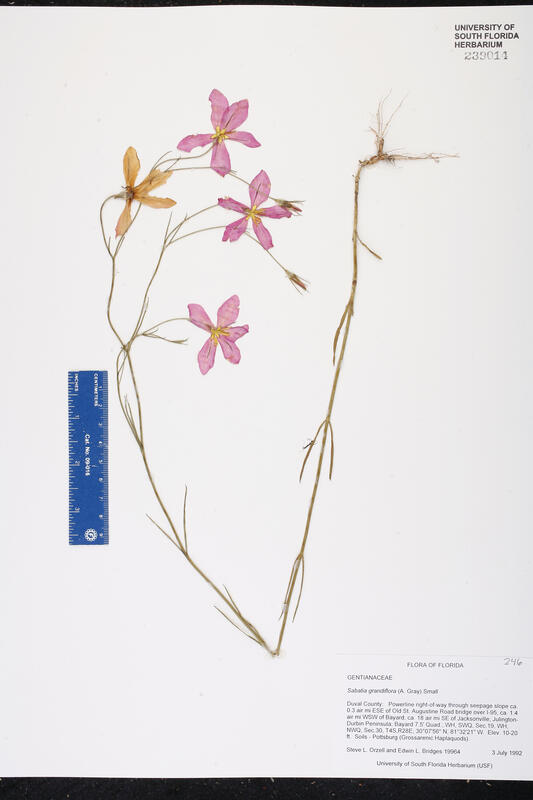
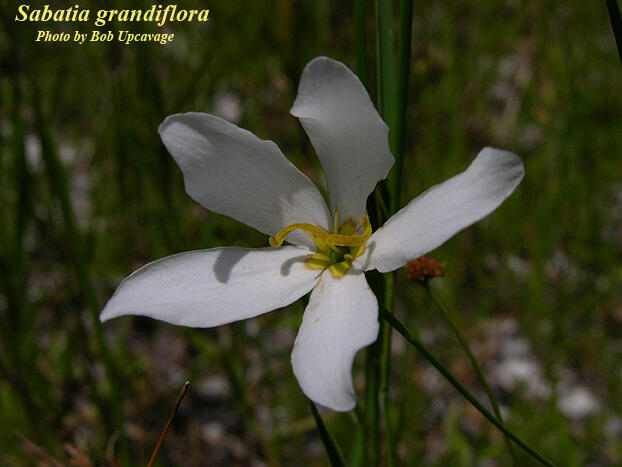
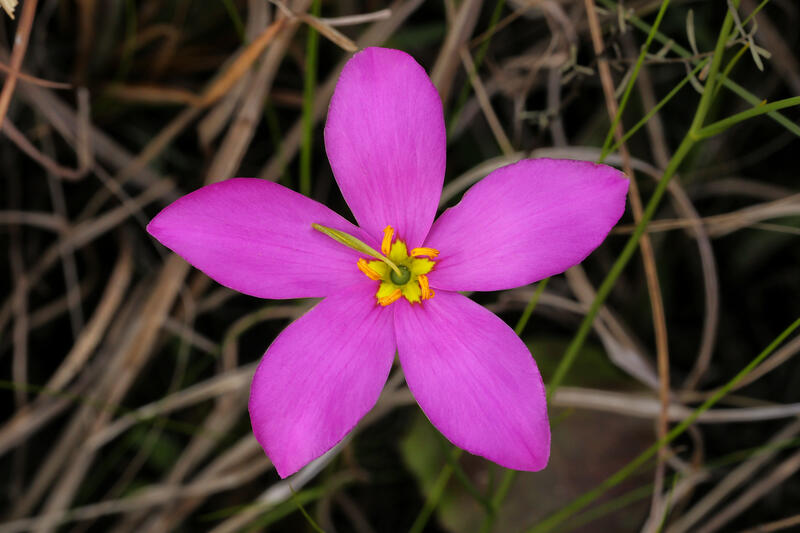
Erect annual 0.6 - 3.6 feet (15 - 110 cm) tall with a single stem bearing several alternate branches. Leaves 0.4 - 2 inches (1 - 5 cm) long and up to 0.4 inch (2 - 10 mm) wide, typically about 5 - 10 times longer than wide, opposite, angled strongly upwards and pressed against the stem, succulent, rigid, roughly hairy, with inconspicuous veins. Flowers are 1 - 2.4 inches (2.6 - 6 cm) wide, with 5 dark pink or, rarely, white petals; the petals are marked at the base with a yellow patch outlined in red that come together to form a star in the center of the flower. A twisted, yellow-green stigma protrudes conspicuously from the bright green ovary. The calyx tube is not winged and the calyx lobes are up to or less than ¾ the length of the petals. Fruit is a narrowly cylindrical capsule up to 0.6 inch (6-15 mm) long.
Annual Sea-pink (Sabatia stellaris) flowers are about 1 inch (2 - 3 cm) wide; its leaves are thin (not succulent); it occurs in brackish marshes.
Slender Marsh-pink (Sabatia campanulata) occurs in pine savannas and bogs throughout Georgia. It is a perennial, often with several stems rising from a woody base; its calyx lobes are more than ¾ the length of petals, sometimes longer than the petals.
Cumberland Rose-gentian (Sabatia capitata) occurs in moist meadows over sandstone or shale in northwest Georgia. For more information, see: https://www.georgiabiodiversity.org/portal/profile?group=plants&es_id=20383
Pine flatwoods, marshes, cypress-gum depressions, limesink ponds, recently planted pine plantations, and powerline and roadside rights-of-way through these habitats.
Large-flowered Rose-gentian (sometimes called Large-flowered Rose-pink) is in the Gentian family. As an annual, it reproduces only by seed, germinating in the spring and dying in the fall after setting seeds. Each flower remains open for several days and a population may remain in flower for weeks. Development of seeds takes 2 - 3 months. The flowers are cross-pollinated by bees, butterflies, and skippers. Caterpillars of Short-Lined Chocolate moth (Agyrostrotis anilis) feed on members of the Sabatia genus.
Surveys should be conducted June – July when the plants are in flower. The plants are slender and few-leaved and hard to spot unless in flower.
Georgia, Florida, Alabama. It is rare or vulnerable throughout its range.
Ditching, draining, and filling of wetland habitat; conversion of habitat to pine plantations, pastures, or development. Fire suppression.
| Threat 1 | Threat 2 | Threat 3 | |
|---|---|---|---|
| General Threat | Transportation & Service Corridors | Agriculture & aquaculture | Energy production & mining |
| Specific Threat | None | None | None |
Sabatia grandiflora is ranked S1 by the Georgia Department of Natural Resources, indicating that it is critically imperiled in the state. Six populations have been documented in Georgia, all confirmed in the last 20 years, but only one occurs on conservation land.
Protect flatwoods, bogs, savannas, and isolated wetlands from ditching, draining, and conversion. Apply prescribed fire every 2 - 3 years, preferably in the growing season. Avoid use of herbicide spray in rights-of-way. Time mowing of rights-of-ways before plants begin their spring growth or after seed dispersal in the fall.
GADNR. 2019. Element occurrence records for Sabatia grandiflora. Georgia Department of Natural Resources, Wildlife Resources Division. Social Circle, Georgia.
Godfrey, R.K. and J.W. Wooten. 1981. Aquatic and wetland plants of southeastern United States. University of Georgia Press, Athens.
Hilty, J. 2019. Species account for Common Rose Pink, Sabatia angularis. Illinois Wildflowers. https://www.illinoiswildflowers.info/prairie/plantx/cm_rosepink.htm
Huegel, C. 2011. Large-flowered Marsh-pink – Sabatia grandiflora. Hawthorn Hill, Pinellas County, Florida. http://hawthornhillwildflowers.blogspot.com/2011/02/large-flowered-marsh-pink-sabatia.html
NatureServe. 2020. Species account for Sabatia grandiflora. NatureServe Explorer: an online encyclopedia of life. NatureServe, Arlington, Virginia. https://explorer.natureserve.org/Taxon/ELEMENT_GLOBAL.2.130711/Sabatia_grandiflora
Perry, J.D. 1971. Biosystematic studies in the North American Genus Sabatia (Gentianaceae). Rhodora 73(795): 309-369.
Weakley, A.S. 2015. Flora of the southern and mid-Atlantic States. University of North Carolina Herbarium, University of North Carolina, Chapel Hill. http://www.herbarium.unc.edu/flora.htm
Wilbur, R.L. 1955. A revision of the North American genus Sabatia (Gentianaceae). Rhodora 57(674): 43-71.
Linda G. Chafin
Linda G. Chafin, 23 April 2020: original account.