


Loading profile. Please wait . . .
Ammospiza maritima macgillivraii (Audubon, 1834)
MacGillivray's Seaside Sparrow




Federal Protection: No US federal protection
State Protection: No Georgia state protection
Global Rank: G4T3
State Rank: S3
Element Locations Tracked in Biotics: Yes
SWAP 2015 Species of Greatest Conservation Need (SGCN): Yes
SWAP 2025 Species of Greatest Conservation Need (SGCN): Yes
2025 SGCN Priority Tier: Highest Conservation Concern
Element Occurrences (EOs) in Georgia: 25
Habitat Summary for element in Georgia: Tidal low marsh on or adjacent to creek levees
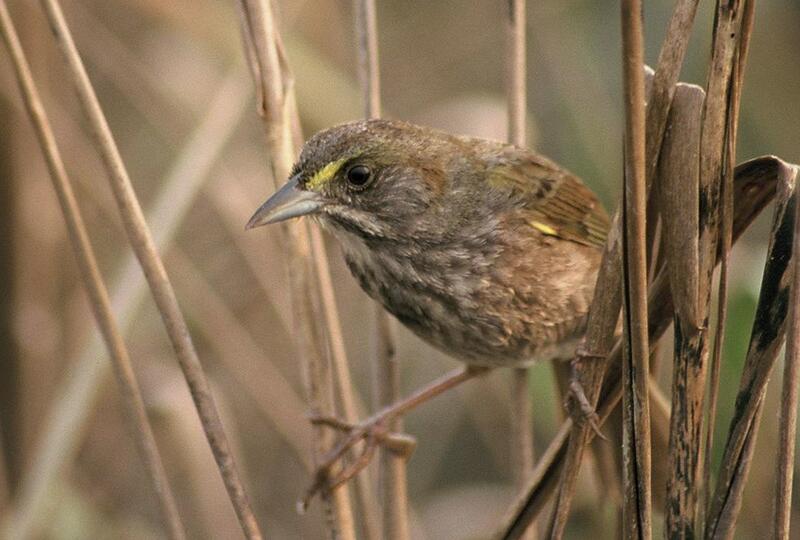
Larger sparrow with large pointed gray bill. Head is dark dusky gray with brown and olive tones. Thick sulfur yellow supraloral line, which is wide at base of bill and narrows to a point above the eye. White throat dissected by dark malar (mustache) stripe. Dark gray chest, flanks, stomach and abdomen. Faint streaking on chest. Back is dark gray with some brown streaking and often some olive and black color. Upper wings are brown with some chestnut and black. The outermost edge of the wing from the alula (small thumb-like projection) to the base of the primary feather is sulfur yellow; however, this color is usually only visible when the bird is excited, agitated, or in hand. Tail feathers are brown with sharply pointed tips. Legs are pink to grayish.
The northern subspecies of the seaside sparrow looks nearly identical. There are some subtle differences in plumage coloration, although described differences may be difficult to distinguish in the field, particularly if the bird is not in hand. Also, there is some debate as to whether these plumage characteristics can be used to differentiate the subspecies. Genetic analysis is the best way to tell the subspecies apart, but season of occurrence can sometimes be used effectively as well. Birds found in Georgia from May through September can be assumed to be MacGillivray’s, while those encountered from October through early April could be either subspecies.
In Georgia, this bird nests in higher elevation areas of low saltmarsh, particularly natural levees along tidal creeks. These areas are dominated by smooth cordgrass (Spartina alterniflora), and to a lesser extent, black needle rush (Juncus roemerianus). Short marsh grasses such as saltgrass (Distichlis spicata) may also occasionally be used. In winter, this subspecies uses a wider array of saltmarsh habitat and appears to be widely dispersed across much of the marsh, except at high tide when much of the marsh is flooded and birds retreat to taller vegetation, particularly areas at the marsh-upland interface.
Grasshoppers, leaf hoppers, true bugs, flies and their larvae, moths, and various other insects, spiders and their egg cases, sand fleas, amphipods, mollusks, and small crabs. Seeds, particularly cordgrass, are eaten as well, especially in winter.
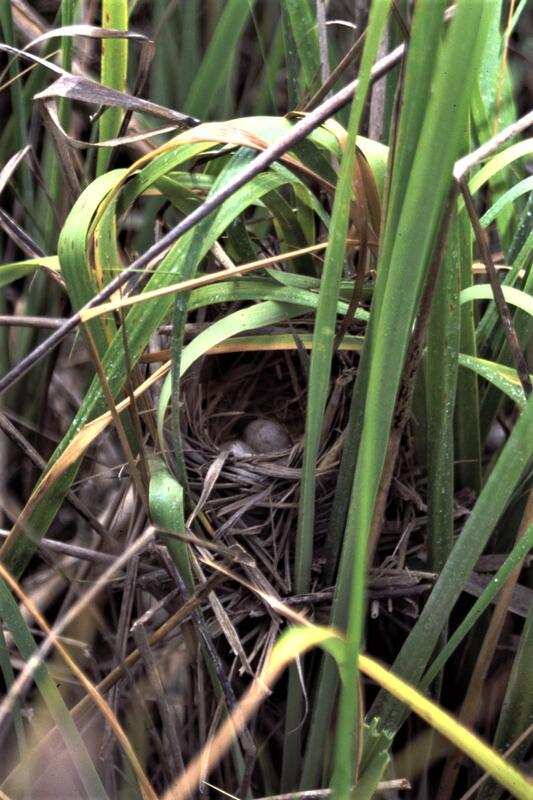
The MacGillivray’s seaside sparrow is restricted to salt and brackish marsh habitats in Georgia. It is considered resident, although little is known about post breeding movement patterns. Nesting begins in early to mid-April and continues as late as August. The female selects a nest site within the male’s territory, constructing an open cup nest out of grass several inches to a meter or more above the ground. Most often, the nest is placed in cordgrass or black needle rush, but small trees such as groundsel tree (Baccharis halimifolia), near the marsh edge have been used. Nests supported by cordgrass often have a canopy woven from the tips of the supporting grass stems. This canopy shades the nest and reduces its visibility. Height above the ground is strongly influenced by tidal amplitude, particularly maximum flooding levels during spring tides (monthly extreme tides), and visibility to predators. This species tries to nest high enough to avoid tidal flooding, while at the same time low enough in the vegetation to be less detectible by predators. The nesting cycle is one of the shortest for a passerine and often synchronized to fit between monthly high tide events, an apparent adaptation to avoid flooding. However, research has shown that when a nest has been lost to predation the adults usually rebuild soon after, often out of synchrony with the tidal cycle, making the new nest more susceptible to flooding. Nest loss due to flooding and predation is very common and birds often renest several times during a breeding season. Clutch size is normally 3-5 eggs, with later clutches generally being smaller. Eggs are incubated for 12-13 days before hatching. Fledging occurs 9-11 days later. Active nests are often found very close to one another, sometimes only a few meters apart, but aggression toward neighbors is rare. Feeding occurs in open stands of cordgrass, along muddy edges of tidal creeks, and along the wrack line.
A follow-up to the (2013-2015) point count surveys and nesting study conducted by a University of Georgia Ph.D. student. Repeat surveys of all points as well as possible addition of points further from the mainland. This would be useful to refine population estimates and, if done long-term, could be used to document population trends. A follow-up nesting study, using sites that are further from the mainland and islands, would be useful in determining if predation rates, flooding, and other mortality factors occur at comparable rates to sites nearer land, like most of those of this earlier study. Additional DNA sampling (larger sample size) to get more complete profiles to aid in deciphering genetic make-up and relationship to the South Carolina population, which may be unique from the birds found in Georgia and Florida.
Atlantic Coast salt and brackish marsh from South Carolina to northeast Florida.
Habitat loss and excessive tidal flooding due to sea level rise. Excessive predation by land-based mammalian (e.g., raccoons) and avian predators (e.g., crows) whose numbers are likely accentuated by human activities.
| Threat 1 | Threat 2 | Threat 3 | |
|---|---|---|---|
| General Threat | Other options | Climate change & severe weather | Climate change & severe weather |
| Specific Threat | Other threat | Storms & flooding | Habitat shifting & alteration |
Recent survey work, habitat modeling, and genetics sampling has revealed that this subspecies has much smaller numbers and is more threatened by sea level rise than previously thought. We now know that Georgia harbors a significant portion of the entire population of MacGillivray’s seaside sparrow making our role in its conservation all the more critical. Known nesting concentrations occur along the South Newport River just south of Colonel’s Island in Liberty County, east of the Torras Causeway (St. Simons Island), the area west of Sapelo Island, the area west of Wassaw Island, northeast of Ft. McAlister State Park, and at several other locations. Smaller numbers can be found scattered throughout the saltmarsh where appropriate habitat exists.
Although Georgia has extensive salt and brackish marsh (153,000 ha) much of this habitat is threatened by sea level rise and other factors. Habitat models predict that by the year 2100 only a small fraction of suitable nesting habitat for the MacGillivray’s seaside sparrow will remain in Georgia (although considerable uncertainty surrounds these estimates). This, coupled with higher spring tides and an increased frequency and intensity of hurricanes and other storm events caused by climate change could lead to local extirpation of this subspecies, or even possibly its extinction. Better predictive models need to be developed to more accurately guide conservation planning and actions. Acquisition of uplands adjacent to saltmarsh that will allow marsh migration may be one of the most critical steps that can be taken to mitigate habitat loss. Application of thin layers of sediment to raise marsh elevation in key areas is another action that appears to show promise in mitigating the effects of sea level rise.
Arnow, I. F. 1906. The seaside sparrow nesting in bushes. Auk 23:226.
Burleigh, T. D. 1958. Georgia Birds. University of Oklahoma Press, Norman, OK.
Hunter, E. A. 2016a. A population status assessment for MacGillivray’s Seaside Sparrows (Ammodramus maritimus macgillivraii) in Georgia. Imperiled Species Final Report to the Georgia Department of Natural Resources (1 February 2016). University of Georgia, Athens.
Hunter, E. A. 2016b. Vulnerability of Salt Marsh Bird Populations to Sea Level Rise. Ph.D. dissertation. University of Georgia, Athens, GA. 164 Pages.
Kirwan, M. L., S. Temmerman, E. E. Skeehan, G. R. Guntenspergen, and S. Fagherazzi. 2018. Overestimation of marsh vulnerability to sea level rise. Nature Climate Change 6(3):253-260.
Martin, A. C., H. S. Zim, and A. L. Nelson. 1951. American Wildlife and Plants: A Guide to Wildlife Food Habits. McGraw-Hill Book Company, Inc., New York, NY.
Post, W., and J. S. Greenlaw. 1994. Seaside Sparrow (Ammodramus maritimus). In A. Poole and F. Gill, eds., The Birds of North America, No. 127. The Academy of Natural Sciences, Philadelphia, PA; The American Ornithologists’ Union, Washington, DC.
Tomkins, I. R. 1941. Notes on MacGillivray’s Seaside Sparrow. Auk 58:38-51.
Schneider, T. M. 2010. Seaside Sparrow. Pp. 382-383 In The Breeding Bird Atlas of Georgia, T. M. Schneider, G. Beaton, T. S. Keyes, and N. A. Klaus, eds. University of Georgia Press, Athens, GA.
U. S. Fish and Wildlife Service. 2018. Species Status Assessment Report for the MacGillivray’s Seaside Sparrow (Ammodramus maritimus macgillivraii) Version 1.1 (January 2018). U. S. Fish and Wildlife Service Region 4, Atlanta, GA.
Todd M. Schneider
12-10-2018