Loading profile. Please wait . . .
Euphorbia purpurea (Raf.) Fern.
Glade Spurge




Federal Protection: No US federal protection
State Protection: No Georgia state protection
Global Rank: G3
State Rank: S1
Element Locations Tracked in Biotics: Yes
SWAP 2015 Species of Greatest Conservation Need (SGCN): Yes
SWAP 2025 Species of Greatest Conservation Need (SGCN): Yes
2025 SGCN Priority Tier: High Conservation Concern
Element Occurrences (EOs) in Georgia: 1
Habitat Summary for element in Georgia: Seeps over amphibolite
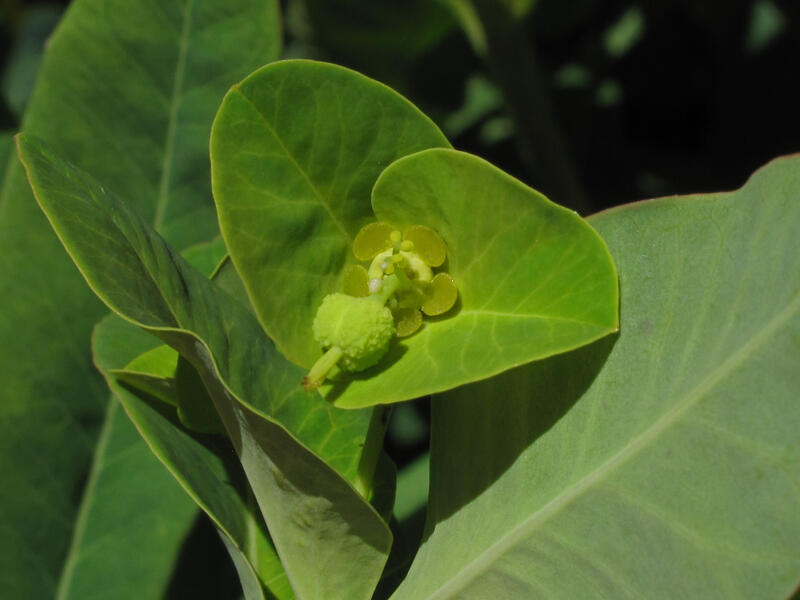
Perennial herb with smooth, erect stems to 3 feet (1 meter) tall (rarely to 4 feet, 1.3 meters) arising from a thick rootstock. Leaves are 2 - 4 inches (5 - 10 cm) long and 0.5-1 inch (1.3 - 3 cm) wide, usually opposite, oblong or elliptic, with blunt tips and rounded or wedge-shaped bases, entire margins, and a prominent, white midvein; both leaf surfaces are hairless or nearly so, and the lower surface is whitened; there is no or a very short leaf stalk. Leafy bracts directly below the inflorescence are smaller than the leaves and oval to kidney-shaped, often tinged with purple. As with all members of the genus Euphorbia, the inflorescence is a cyathium consisting of several unisexual flowers: one ovary-bearing flower plus 10 - 15 flowers composed of a single stamen, none with petals or sepals. These flowers are so closely arranged that they appear to be one bisexual flower surrounded by a whorl of 5 yellowish-green, kidney-shaped nectar glands. The most obvious part of the inflorescence is the rounded, three-lobed ovary which droops from the center and develops into a brown, wart-covered fruit about 0.25 inch (6 - 6.8 mm) long. Each lobe of the fruit contains one silvery-brown seed. All parts of the plant ooze a milky latex when cut or broken.
Although there are more than 20 species of Euphorbia in Georgia, few occur in our Blue Ridge counties. Two native species, Eastern Flowering Spurge (Euphorbia corollata) and Southeastern Flowering Spurge (Euphorbia pubentissima), occur in northeast Georgia in dry, upland forests and woodlands. They are distinguished from Purple Spurge by their habitat, alternate leaves, and white nectar glands (which look like five small, white petals). Caper Spurge (Euphorbia lathyris), a weedy European species known in Georgia only from Rabun County roadsides, has narrow, linear leaves and smooth (not warty) fruits. Leafy Spurge (Euphorbia virgata) is one of the most invasive exotic species in North America, but has not yet been found in the southeast; its leaves are narrowly linear.
This species should not be confused with the 'Purpurea’ cultivar of Euphorbia amygdaloides, an ornamental species of Eurasian origin. Widely sold on the internet, the cultivar has purple foliage and reddish stems; it has not been recorded as a garden escape.
Florida Spurge (Euphorbia floridana, Georgia Special Concern) occurs in sandhill and xeric scrub in southeast Georgia. For more information, see: http://www.efloras.org/florataxon.aspx?flora_id=1&taxon_id=250101650
Georgia Spurge (Euphorbia georgiana, Georgia Special Concern) occurs on granite outcrops in two Georgia Piedmont counties. For more information, see: http://www.efloras.org/florataxon.aspx?flora_id=1&taxon_id=250101633
Flatwoods Spurge (Euphorbia inundata var. inundata, Georgia Special Concern) occurs in pine flatwoods and on streambanks in Georgia’s Coastal Plain. For more information, see: http://www.efloras.org/florataxon.aspx?flora_id=1&taxon_id=250101652
Carolina Ipecac (Euphorbia ipecacuanhae, Georgia Special Concern) occurs in xeric sandhills in Georgia’s Coastal Plain. For more information, see: http://www.efloras.org/florataxon.aspx?flora_id=1&taxon_id=250101539
In Georgia, Purple Spurge grows in wet seepages over a type of bedrock – amphibolite – that raises the pH of soils which form above it. Elsewhere in its range, Purple Spurge occurs in dry to moist to swampy forests, outcrops and glades, streamsides, and bottomlands, always in association with calcareous rock such as amphibolite or dolomite.
Purple Spurge is a perennial herb that reproduces vegetatively by the spread of stout rhizomes and sexually by seed. Plants begin growth in April, flower in May and early June, and reach their full height in mid-June. As described above, plants are monoecious, i.e. female and male flowers are in separate structures on the same plant – the flowers mature at different times to prevent self-pollination. Most Euphorbia species are pollinated by insects that are attracted to nectar produced in glands on or around the cyathium. Seed dispersal takes place from late June to early July, after which the plants begin to senesce. Seeds are dispersed explosively from late June to early July; the walls separating the three lobes of the fruit dry out and contract, suddenly splitting open with a loud pop and propelling seeds 3 - 5.8 meters from the parent plant.
Surveys should be conducted during flowering and fruiting, May–June or early July.
Georgia, north to Ohio, Pennsylvania, and New Jersey. It is rare and threatened throughout its range and was considered a Category 2 candidate for federal listing in the 1980s.
Deer browsing, invasion by exotic species such as Japanese Stilt Grass (Microstegium vimineum) and Japanese Knotweed (Reynoutria japonica, syn. Polygonum cuspidatum), logging, alteration of hydrology by ditching, draining, and filling, and other human disturbances.
| Threat 1 | Threat 2 | Threat 3 | |
|---|---|---|---|
| General Threat | Transportation & Service Corridors | Natural system modifications | Invasive & other problematic species, genes & diseases |
| Specific Threat | None | None | None |
Euphorbia purpurea is ranked S1 by the Georgia Department of Natural Resources, indicating that it is critically imperiled in Georgia. Only one population has been discovered in Georgia; it occurs in a powerline right-of-way that traverses a private resort property.
Protect individual plants from deer browsing with fencing. Monitor site for sign of feral hogs and if necessary protect plants. Monitor site for exotic plants and remove if necessary. Avoid any hydrology-altering activities. Coordinate site management with utility ownership. Flag plants to prevent accidental mowing, spraying, or vehicle damage. Bring plants into ex situ safeguarding; this species is reported as easy to grow from seed and cuttings.
Center for Plant Conservation. 2019. Euphorbia purpurea species profile. Accessed 20 May 2019. https://saveplants.org/national-collection/plant-search/plant-profile/?CPCNum=1910
Fairchild Tropical Garden. Going ballistic. Fairchild Tropical Garden Virtual Herbarium. Accessed 20 May 2019. http://www.virtualherbarium.org/gardenviews/GoingBallistic.html
Federal Register. 1985. Endangered and threatened wildlife and plants; review of plant taxa for listing as endangered or threatened species. Federal Register (50)188, 27 September 1985.
GADNR. 2019. Element occurrence record for Euphorbia purpurea. Georgia Department of Natural Resources, Wildlife Resources Division, Social Circle.
Godfrey, R.K. and J.W. Wooten. 1979. Aquatic and wetland plants of southeastern United States. University of Georgia Press, Athens.
Loeffler, C.C. and B.C. Wegner. 2000. Demographics and deer browsing in three Pennsylvania populations of the globally rare Glade Spurge, Euphorbia purpurea (Raf.) Castanea (65)4: 273-290. https://www.jstor.org/stable/4034009?seq=1#metadata_info_tab_contents
NatureServe. 2019. Euphorbia purpurea species profile. NatureServe Explorer: An online encyclopedia of life, Version 7.1. NatureServe, Arlington, Virginia. http://explorer.natureserve.org/servlet/NatureServe?search NameEuphorbia+purpurea. Accessed 19 May 2019.
Weakley, A.S. 2015. Flora of the southern and mid-Atlantic States. University of North Carolina Herbarium, University of North Carolina, Chapel Hill.
Linda G. Chafin
Linda G. Chafin: 20 May 2019, original account