

Loading profile. Please wait . . .
Liparis loeselii (L.) L.C. Rich.
Fen Orchid




Federal Protection: No US federal protection
State Protection: No Georgia state protection
Global Rank: G5
State Rank: S1
Element Locations Tracked in Biotics: Yes
SWAP 2015 Species of Greatest Conservation Need (SGCN): Yes
SWAP 2025 Species of Greatest Conservation Need (SGCN): No
2025 SGCN Priority Tier:
Element Occurrences (EOs) in Georgia: 2
Habitat Summary for element in Georgia: Ultramafic fens
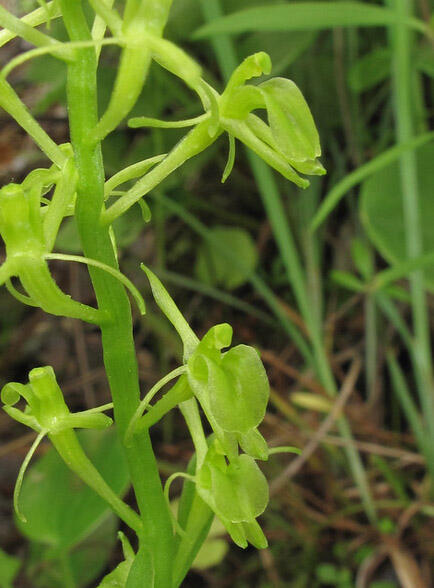
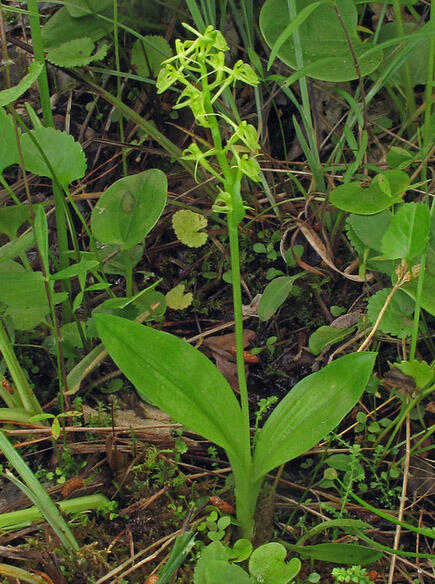
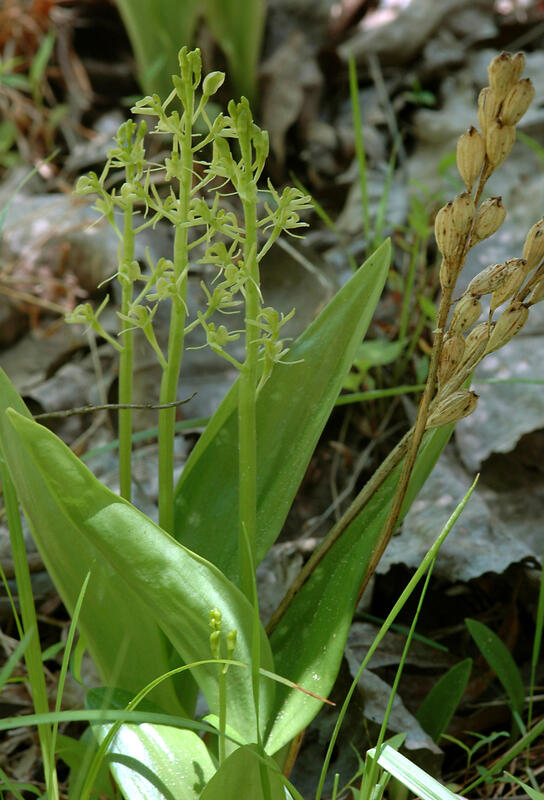
Perennial herb rising from an overwintering bulb-like base (a pseudobulb). Stems are up to 10 inches (6 - 26 cm) tall, succulent, pale green or yellowish-green, angled, and hairless, leafless except at the base. The leaves are up to 7 inches long and 2.8 inches wide (3.7 - 18 cm long, 1 - 4 cm wide), two in number and held nearly erect at the base of the stem, yellow-green, hairless, narrowly elliptic in shape, with a deeply channeled midvein. The flowers are pale green or yellowish-green, held on short stalks in a cluster at the top of the stem, with 3 narrow, spreading sepals; two narrow, drooping, tubular petals; and a prominent, oval or oblong, down-curved, sometimes translucent lip petal with wavy margins; there is no spur. Fruits are oval capsules up to 0.5 inch long (3 - 6 mm), held erect, with many dust-like seeds.
Large Tway-blade (Liparis liliifolia) is similar to Fen Orchid but its lip petal is wider, and maroon, brown, or puce.
Several native orchids have green flowers: Small Green Wood Orchid (Platanthera clavellata), Green Fringed Orchid (P. lacera), Toothed Rein Orchid (Habenaria floribunda), and Water-spider Orchid (H. repens). Each of these orchids have leafy stems and flowers with a tubular spur that extends down and behind the flower.
More than 30 species of orchid are rare in Georgia.
In Georgia, Fen Orchid is known only in open, sunny seepages over serpentine (ultramafic) bedrock surrounding the base of Brasstown Bald.
In Georgia, a single new shoot of Fen Orchid emerges from the perennial pseudobulb in late April and produces a pair of basal leaves; flowers open about a month later, and mature fruits develop in early summer. Insect pollinators are unknown for this species, and the flowers may be self-pollinated. One study found that pollen was transferred from the anther to the stigma by the action of rain drops. As with other orchids, the seeds are dust-like and lack an endosperm; the seeds must form a mycorrhizal relationship with a fungus in order to germinate and nurture a seedling.
Populations of Fen Orchid are short-lived, with mortality in some studied populations reaching 60% in a single year. Heavy seed production, rather than long life of individuals, may account for the survival of populations. Like many orchids, Fen Orchid may disappear belowground for several years between flowering events. One study found that the “probability of any individual present in one year reappearing in the following year was 45%” (McMaster 2001).
Fen Orchid plants are ephemeral–visible aboveground only from mid- to late April to late July.
Fen Orchid is found throughout most of the eastern and midwestern US states and Canadian provinces, with scattered, disjunct populations in the Pacific Northwest. It is rare in most of the states and provinces where it occurs.
Fen Orchid is threatened by habitat destruction, invasive pest plants, woody succession, deer and rabbit browsing, feral hog digging, drought, and hydrological changes.
Liparis loeselii is ranked S1 by the Georgia Department of Natural Resources, indicating that it is critically imperiled in Georgia. There is only one documented population; it occurs on state-owned land in a powerline right-of-way and is frequently monitored.
Liparis loeselii requires full sun and is therefore dependent on moderate, natural disturbance to remove woody plants and reduce competition. Natural disturbances that favor it include windthrow, fire, and beaver browsing. In addition, prescribed fire and hand-clearing accompanied by cut-and-paint herbicide application to woody stumps are recommended.
Catling, P. M. 1980. Rain-assisted autogamy in Liparis loeselii (L.) L. C. Rich. (Orchidaceae). Bulletin of the Torrey Botanical Club 107: 525-529. https://www.jstor.org/stable/pdf/2484083.pdf?refreqid=excelsior%3Ac5a2dc80f267214e03928ba6eac66e69
Magrath, L.K. 2003. Species account for Liparis loeselii. Flora of North America North of Mexico, vol. 26. Accessed 4 October 2019. http://www.efloras.org/florataxon.aspx?flora_id=1&taxon_id=220007680
McMaster, R.T. 2001. The population biology of Liparis loeselii, Loesel's Twayblade, in a Massachusetts wetland. Northeastern Naturalist 8(2):163-178. https://doi.org/10.1656/1092-6194(2001)008[0163:TPBOLL]2.0.CO;2
NatureServe. 2019. Species account for Liparis loeselii. NatureServe Explorer: an online encyclopedia of life, Version 7.1. NatureServe, Arlington, Virginia. Accessed 4 October 2019. https://explorer.natureserve.org/Taxon/ELEMENT_GLOBAL.2.146901/Liparis_loeselii
Weakley, A.S. 2015. Flora of the southern and mid-Atlantic States. University of North Carolina Herbarium, University of North Carolina, Chapel Hill. http://www.herbarium.unc.edu/flora.htm
Linda G. Chafin
Linda G. Chafin, 23 October 2019: original account