


Loading profile. Please wait . . .
Schoenoplectus erectus ssp. raynalii (Schuyler) Lye
Raynal's Bulrush




Federal Protection: No US federal protection
State Protection: No Georgia state protection
Global Rank: G4G5T4T5
State Rank: S1
Element Locations Tracked in Biotics: Yes
SWAP 2015 Species of Greatest Conservation Need (SGCN): Yes
SWAP 2025 Species of Greatest Conservation Need (SGCN): No
2025 SGCN Priority Tier:
Element Occurrences (EOs) in Georgia: 3
Habitat Summary for element in Georgia: Seasonal pond margins
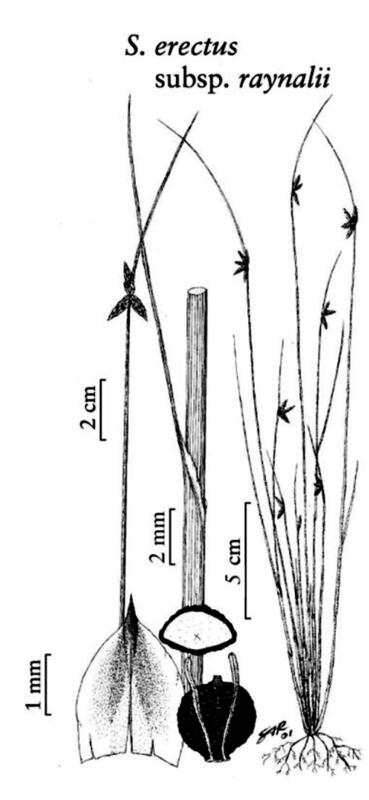
Annual, clump-forming herb with many soft, slender rhizomes forming a dense mat. The stem is 2 - 20 inches (5 - 50 cm) tall, erect, cylindric, and finely ridged (but not three-angled); old fibrous, disintegrating leaves often persist at the base of the stem. Leaves are shorter than or about the same height as the stem, 1 - 2 in number, very narrow, C-shaped in cross-section except flat at the tip; leaf sheaths at the base of the plant often enclose small, seed-bearing flowers. The inflorescence is held at the top of the stem and consists of 1 - 10 oval, pointed, green and reddish-brown spikelets topped by a single erect, leaf-like bract up to 8 inches (20 cm) tall (the bract may appear to be a continuation of the stem). Fruits are seed-like achenes, 1 - 1.6 mm long, that are brownish-black at maturity, covered with horizontal ridges, oval in outline, and slightly bulging on both sides (or may appear slightly three-sided). The scale surrounding the achene is broadly oval, and there are no bristles at the base of the achene. (Achenes produced by the flowers at the base of the stem are twice the size and distinctly three-sided with long beaks.)
Raynal’s Bulrush is one of many species that were once lumped into a single genus, Scirpus. This genus has been split into several genera:
--Scirpus, perennial herbs with minutely warty, three-sided achenes; inflorescence bracts 2-8, usually 3, leaf-like.
--Schoenoplectus, perennial herbs with smooth, two-sided achenes; inflorescence bracts 1-5, leaf-like.
--Schoenoplectiella, annual herbs with ridged achenes; inflorescence bracts 1-3, sometimes leaf-like, or sometimes appearing like a continuation of the culm.
Synonyms for Schoenoplectus erectus ssp. raynalii reflect this nomenclatural history and include: Schoenoplectiella erecta ssp. raynalii, Scirpus erismanae, Scirpus erectus var. raynalii, and Scirpus erectus.
Raynal’s Bulrush is distinguished by its clumping habit, cylindric (not three-angled) stem, single inflorescence bract, reddish-brown spikelet scales, horizontally ridged achene, and a lack of bristles at the base of the achene.
Sharpscale Bulrush (Schoenoplectiella hallii, synonyms: Schoenoplectus hallii, Scirpus hallii, Scirpus supinus var. hallii) is a very rare plant that occurs in peaty sands of pond shores in southwest Georgia. It is very similar to Raynal’s Bulrush but has yellowish-brown (rather than reddish-brown) spikelet scales, and the achenes are concave on one side and bulging on the other (rather than bulging on both sides). For more information, see: http://www.efloras.org/florataxon.aspx?flora_id=1&taxon_id=242357938
Peaty sands of seasonal pond shores, margins of pools in swampy woodlands, and depression ponds in pine flatwoods.
Raynal’s Bulrush is an annual herb that reproduces sexually. It grows around the edges of ponds where fluctuating water levels periodically expose bare sand and mud and discourage competing vegetation. It may disappear from a pond for years, then its seeds will germinate when water levels in the pond drop and bare, wet sand or mud is exposed. Its flowers are wind-pollinated, and its seeds are dispersed by water, gravity, and animals.
Surveys are best conducted during flowering and fruiting (September–October); inflorescences and mature fruits are needed for identification.
Central peninsular Florida, north in the Coastal Plain to south Georgia and south-central South Carolina; also in both old world and new world tropics.
Destruction of habitat by draining and filling ponds. Fire suppression and encroachment by woody plants into pond edges. Trampling by cows. Use of pond edges by off-road vehicles. Lowering of water table by excessive withdrawal from the aquifer. Changes in hydrology due to altered temperature and rainfall patterns related to climate change are likely to negatively effect this species.
Raynal’s Bulrush is ranked S1 by the Georgia Department of Natural Resources, indicating that it is critically imperiled in Georgia. It has been documented only three times in Georgia, and these observations have not been confirmed for many years.
Avoid filling or draining natural ponds. Apply prescribed fire to surrounding uplands every 2-3 years during the growing season, allowing fire to burn into pond edges. Avoid placing firebreaks around ponds. Exclude cattle and off-road vehicles from natural ponds. Prevent permanent drying of ponds by regulating withdrawal from the aquifer. A full survey of south Georgia’s seasonal ponds is needed to confirm the current status of this and other rare pond species. Address climate change.
GADNR. 2019. Element occurrence records for Schoenoplectus erectus ssp. raynalii. Georgia Department of Natural Resources, Wildlife Resources Division. Social Circle, Georgia.
NatureServe. 2019. Species account for Schoenoplectus erectus ssp. raynalii. NatureServe Explorer: an online encyclopedia of life, Version 7.1. NatureServe, Arlington, Virginia. Accessed 8 June 2019. http://explorer.natureserve.org/servlet/NatureServe?searchName=Platanthera+blephariglottis
Smith, S.G. 2002. Species account for Schoenoplectus erectus ssp. raynalii. Flora of North America North of Mexico, vol. 26. Accessed 18 June 2019. http://www.efloras.org/florataxon.aspx?flora_id=1&taxon_id=242357936
Weakley, A.S. 2015. Flora of the southern and mid-Atlantic States. University of North Carolina Herbarium, University of North Carolina, Chapel Hill.
Linda G. Chafin
Linda G. Chafin, 19 June 2019: original account