


Loading profile. Please wait . . .
Clematis morefieldii Kral
Morefield's Leatherflower




Federal Protection: Listed Endangered
State Protection: Endangered
Global Rank: G2
State Rank: S1
Element Locations Tracked in Biotics: Yes
SWAP 2015 Species of Greatest Conservation Need (SGCN): No
SWAP 2025 Species of Greatest Conservation Need (SGCN): Yes
2025 SGCN Priority Tier: Highest Conservation Concern
Element Occurrences (EOs) in Georgia: 2
Habitat Summary for element in Georgia: Limestone woodland
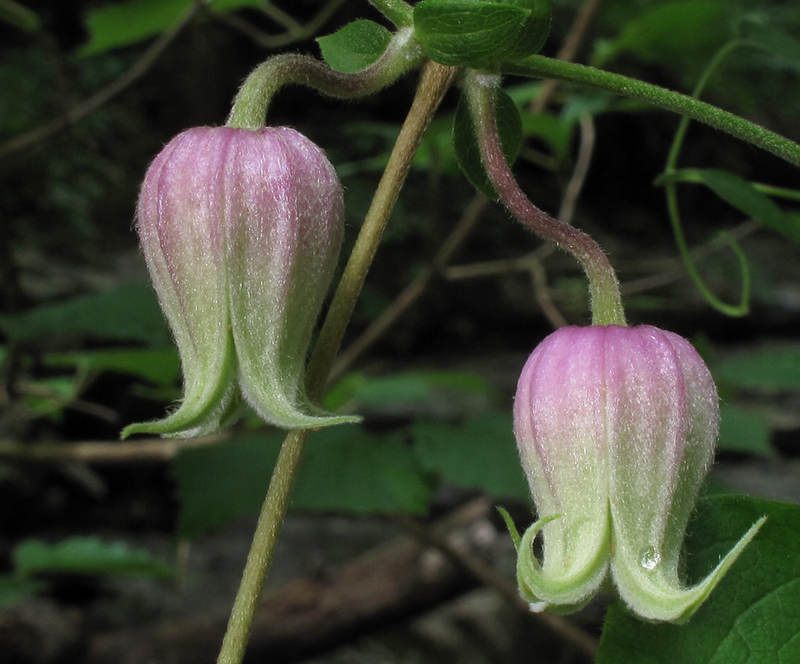
Perennial herbaceous vine with stems up to 15 feet (5 meters) in length, climbing by tendrils over other plants and covered in long, sometimes cobwebby hairs. Leaves are alternate, up to 8 inches long, and composed of 4-10 leaflets and one or more tendrils; leaflets are usually lobed and have densely hairy lower surfaces. Flowers occur singly or in clusters of 2-5 flowers. There are no petals; instead, 5 thick, leathery sepals are fused into a nodding, urn- or bell-shaped flower about 1 inch (2.5 cm) long and wide, greenish-white tinged with pink or rose at the base, and covered with long, silky hairs; the tips of the sepals are curved strongly backward. The flower stalk has a leaf-like bract at or near the base of the stalk. Fruiting clusters contain numerous small, hairy fruits with long, feathery tails.
Common Leather Flower (Clematis viorna) stems are smooth or sparsely hairy, the leafy bract on the flower stalk is well above the base of the stalk, and the outer surface of the flower is sparsely hairy and dark purplish-pink, except for the cream-colored tips. Swamp Leather Flower (C. crispa) occurs in wetlands and has smooth stems. Its flowers are pale pink or lavender and have ruffled edges.
Three other rare species of Clematis occur in northwest Georgia in habitats similar to Morefield’s Leatherflower. Information on these species is available at these links:
Fremont's Leatherflower (Clematis fremontii): https://www.georgiabiodiversity.org/portal/profile?group=plants&es_id=17110
Curly-heads (Clematis ochroleuca): https://www.georgiabiodiversity.org/portal/profile?group=plants&es_id=15351 AND http://www.efloras.org/florataxon.aspx?flora_id=1&taxon_id=233500404
Alabama Leatherflower (Clematis socialis): https://www.georgiabiodiversity.org/portal/profile?group=plants&es_id=16148
Open woodlands over limestone bedrock, on the south and southwest facing slopes of mountains in the Ridge & Valley ecoregion.
Morefield's Leatherflower is a deciduous, perennial, herbaceous vine that climbs with tendrils. It is closely related to seven other Clematis species in Georgia, all of which have flowers with thick, leathery, pink, white, or purple sepals fused together into an urn- or bell-shape. The flowers probably require cross-pollination in order to set fruit, but this has not been researched. The large opening of the flower is visited by bumblebees that suck nectar and gather pollen. The flowers may also be pollinated by butterflies. The long, hairy tails (“beaks”) on the fruits assist with seed dispersal by catching both wind currents and animal fur. All parts of Clematis plants are slightly toxic.
Surveys are best conducted during flowering, mid-May–June, when the plants are most conspicuous. Later in the summer, the “curly-head” fruit cluster is distinctive for the genus and the cobwebby-hairy stems combined with leaflets that have very hairy lower surfaces are useful for identification to species. Plants die back to the ground in the fall.
Morefield's Leatherflower occurs in Alabama, Georgia, and Tennessee. Known from fewer than 25 populations, it is extremely rare and listed as Endangered by the U.S. Fish and Wildlife Service.
In Georgia, Morefield's Leatherflower is not under immediate threat of human disturbance due to its location on a state-owned Wildlife Management Area. However, the low number of plants makes the population vulnerable to extirpation by natural disturbances, and the distance from other known populations poses the threat of inbreeding. In Alabama and Tennessee, Morefield's Leatherflower is heavily impacted by insect and mammal herbivory, which destroys buds, flowers, fruits, and seeds, and appears to have low seed viability. Its habitat in Alabama and Tennessee has been logged, quarried, and invaded by exotic plant species, and populations have been lost to residential development, road widening, and herbicide use.
| Threat 1 | Threat 2 | Threat 3 | |
|---|---|---|---|
| General Threat | Invasive & other problematic species, genes & diseases | Natural system modifications | Transportation & service corridors |
| Specific Threat | None | None | None |
Morefield’s Leatherflower is ranked S1 by the Georgia Department of Natural Resources, indicating that it is critically imperiled in Georgia. It is listed as Endangered by the State of Georgia and the U.S. Fish and Wildlife Service. Only one population of Morefield’s Leatherflower has been found in Georgia; it occurs on a state-owned Wildlife Management Area in northwest Georgia. This location and its rugged, rocky habitat provides some protection from human disturbance.
Conduct surveys for new populations. Protect plants from human disturbance. Reduce the size of deer herds.
Kral, R. 1987. A new "Viorna" Clematis from northern Alabama. Annals of the Missouri Botanical Garden 74(3): 665-669. https://www.jstor.org/stable/2399332?seq=1#metadata_info_tab_contents
NatureServe. 2018. Clematis morefieldii species account. NatureServe Explorer, Arlington, Virginia. http://explorer.natureserve.org/servlet/NatureServe? searchName=Clematis+morefieldii
Paris, K.J. 2013. Population status and reproductive biology of Clematis morefieldii, a federally endangered plant. Master’s thesis, Auburn University, Auburn, Alabama. http://etd.auburn.edu/xmlui/bitstream/handle/10415/3979/Kyle%20Jordan%20Paris%20ETD.pdf?sequence=2&ts=1438245344292
Paris, K.J., K. Burgess, A.N. Wright, R.S. Boyd. 2015. Impact of insecticide treatment on herbivory and reproductive success of the federally endangered plant Clematis morefieldii Kral. Castanea 80(4): 229-242. https://www.jstor.org/stable/26353845?seq=1#metadata_info_tab_contents
Paris, K.J., K. Burgess, A.N. Wright, R.S. Boyd. 2016. Reproductive biology of the federally endangered Clematis morefieldii Kral (Ranunculaceae). Castanea 81(3): 175-187. https://doi.org/10.2179/15-062
Pringle, J.S. 2010. Species account for Clematis morefieldii. Flora of North America, Vol. 7. http://www.efloras.org/florataxon.aspx?flora_id=1&taxon_id=250094628.
USFWS. 2019. Morefield’s Leather Flower (Clematis morefieldii) species profile and related documents. U.S. Fish and Wildlife Service, Atlanta, Georgia. https://ecos.fws.gov/ecp0/profile/speciesProfile?sId=133
Weakley, A.S. 2015. Flora of the southern and mid-Atlantic States. University of North Carolina Herbarium, University of North Carolina, Chapel Hill. http://www.herbarium.unc.edu/flora.htm
Linda G. Chafin
Linda G. Chafin, May 2019: original account