

Loading profile. Please wait . . .
Chelyoxenus xerobatis Hubbard, 1894
Gopher Tortoise Hister Beetle




Federal Protection: No US federal protection
State Protection: No Georgia state protection
Global Rank: G2G3
State Rank: S2
Element Locations Tracked in Biotics: Yes
SWAP 2015 Species of Greatest Conservation Need (SGCN): Yes
SWAP 2025 Species of Greatest Conservation Need (SGCN): Yes
2025 SGCN Priority Tier: High Conservation Concern
Element Occurrences (EOs) in Georgia: 4
Habitat Summary for element in Georgia: Gopher Tortoise burrows
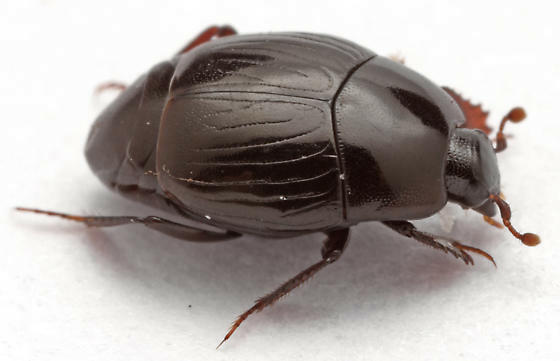
A rather small (3.0 – 3.8 mm [0.2 inches]) oval-shaped, shiny black (without metallic reflections) histerid beetle. Each elytra with five dorsal striae, the four outer striae are entire or nearly so, the fifth abbreviated. Claws of middle and hind tarsi strikingly unequal in length, the outer claw spine-like and minute (approximately one-quarter the length of the inner claw). The appendages of beetles in this family (Histeridae) can be withdrawn into various slots and grooves. A published description is found in Hubbard (1894).
The great disparity in length of tarsal claws is a diagnostic character. Also, distinguished from similar histerid species by the smoothness of the elytra, the more complete elytral striations, and a less ovate/convex body form. Chelyoxenus is monotypic.
This beetle is known only from gopher tortoise burrows and is an obligate commensal species. Habitats that support gopher tortoises (open-canopied longleaf pine – turkey oak – wiregrass sandhills, oldfields and similar environments) potentially support populations of this species.
The predaceous adults/larvae have been found in gopher tortoise dung (inside or at tortoise burrow entrances) among the coprophagous larvae of other invertebrate species where they feed on other arthropods, probably including fly larvae. Small dead and dying invertebrates may also be consumed.
Very poorly known. These beetles may be locally common, burrowing in the sand throughout subterranean portions of some tortoise burrows. The number of generations per year is unknown.
The species is poorly-known in Georgia due to rarity and/or a lack of historic surveys. Dedicated invertebrate species inventories for gopher tortoise burrow commensal species, including this beetle, in naturally-functioning sandhill habitats located on protected lands in Georgia are sorely needed. In Florida, specimens have been collected by scooping then sieving sand and dung from the mouth of active tortoise burrows and by using Gopher Tortoise Burrow Facade Traps (developed by David Almquist of the Florida Natural Areas Inventory).
In Georgia, this beetle may occur in those portions of the Coastal Plain supporting gopher tortoise populations. Populations are distributed throughout most of Florida and are known from Mississippi.
Loss, degradation and fragmentation of naturally-functioning longleaf pine sandhill habitats, with concomitant declines in gopher tortoise numbers, are the primary threats facing this species.
| Threat 1 | Threat 2 | Threat 3 | |
|---|---|---|---|
| General Threat | Natural system modifications | Natural system modifications | Human intrusions & disturbance |
| Specific Threat | Fire & fire suppression | Other ecosystem modifications | Work & other activities |
Poorly known.
Conduct additional surveys for the beetle throughout its presumed Georgia range. Conservation of this poorly-known species would be enhanced by additional studies of its life history and ecology. Preserve and appropriately manage (with regular prescribed fire) longleaf pine sandhill landscapes supporting gopher tortoise populations located throughout the Coastal Plain region of southern Georgia.
Deyrup, M.A. 1994. Threatened: Gopher Tortoise Hister Beetle, Chelyoxenus xerobatis Hubbard. Pp. 477−479, In M. Deyrup and R. Franz (eds.), Rare and Endangered Biota of Florida: Volume 4 − Invertebrates. University Press of Florida, Gainesville.
Kovarik, P.W., and M.S. Caterino. 2001. Histeridae, Gyllenhal, 1808. Pp. 212−227, In American Beetles, Volume 1- Archostemata, Myxophaga, Adephaga, Polyphaga: Staphlyliniformia. CRC Press, Boca Raton, FL.
Hubbard, H.G. 1894. The insect guests of the Florida land tortoise. Insect Life 6: 302−315.
Jackson, D.R., and D.T. Almquist. 2012. Status, Distribution, and Biology of Florida’s Rare Invertebrates: A Florida's Wildlife Legacy Initiative Project, Final Report. Florida Natural Areas Inventory, Tallahassee.
Jackson, D.R., and E.G. Milstrey. 1989. The fauna of gopher tortoise burrows. Pages 86-98 in J.E. Diemer, D.R. Jackson, J.L. Landers, J.N. Lane, and D.A. Wood, editors. Gopher Tortoise Relocation Symposium Proceedings, Nongame Wildlife Program Technical Report #5. Florida Game and Fresh Water Fish Commission, Tallahassee, Florida.
Lackner, T. 2014. Phylogeny of the Saprininae reveals interesting ecological shifts in the history of the subfamily (Coleoptera: Histeridae). Zoological Journal of the Linnean Society 172(3):521−555.
Young, F.N., and C.C. Goff. 1939. An annotated list of the arthropods found in the burrows of the Florida gopher tortoise. Florida Entomologist 22(4):53−62.
Dirk J. Stevenson
1 December 2018