


Loading profile. Please wait . . .
Machimus polyphemi Bullington and Beck, 1991
Gopher Tortoise Robber Fly




Federal Protection: No US federal protection
State Protection: No Georgia state protection
Global Rank: G2
State Rank: S1?
Element Locations Tracked in Biotics: Yes
SWAP 2015 Species of Greatest Conservation Need (SGCN): Yes
SWAP 2025 Species of Greatest Conservation Need (SGCN): Yes
2025 SGCN Priority Tier: Highest Conservation Concern
Element Occurrences (EOs) in Georgia: 25
Habitat Summary for element in Georgia: Gopher Tortoise burrows
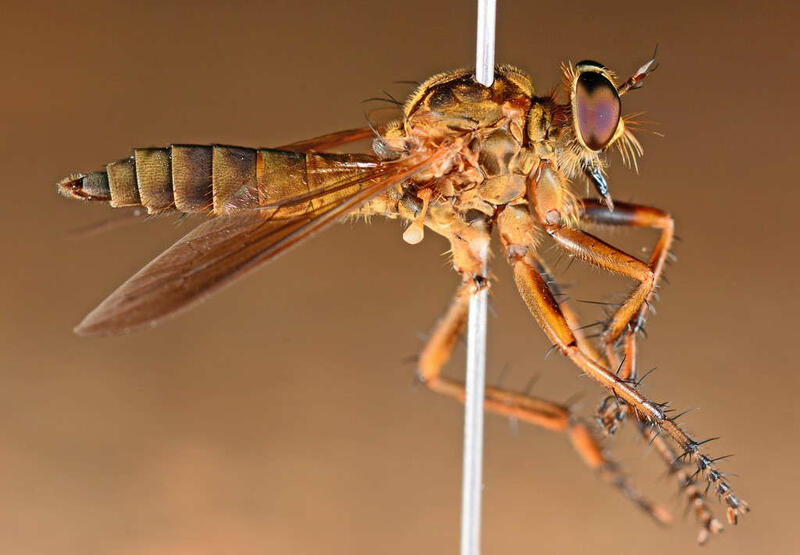
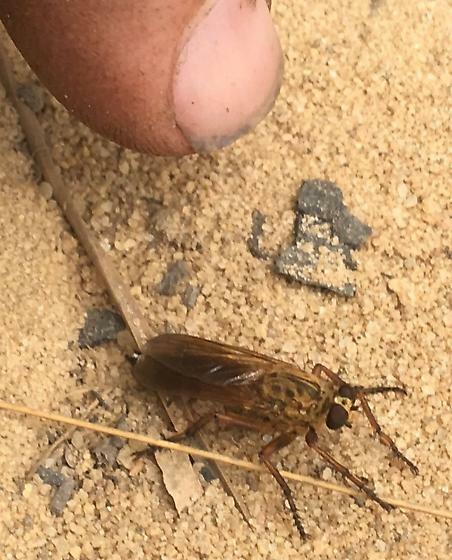
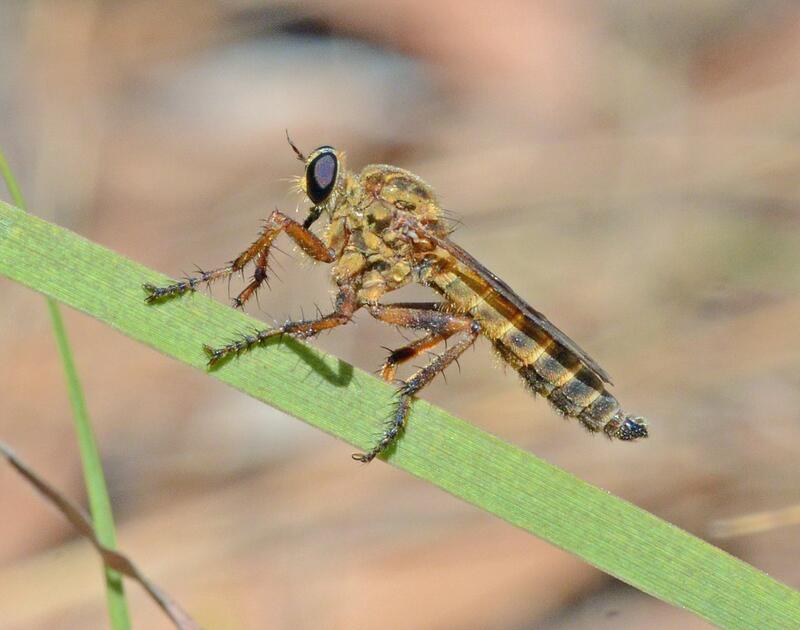
Description: This medium-large sized (10.5-17.5 mm [0.4-0.7 inches]) robber fly has a dense covering of shining golden-brown minute hairs and the thorax has a black stripe bisected by a golden band. Like other robber flies the legs are elongate and heavily-spined (for holding prey, perching) and the compound eyes are prominent. A published description is found in Bullington and Beck (1991).
No other robber flies are known to inhabit gopher tortoise burrows and none of the Machimus species found in the coastal plain are golden in color.
This robber fly is an obligate commensal of gopher tortoise burrows. Habitats that support tortoise populations (open-canopied longleaf pine – turkey oak – wiregrass sandhills, and similar environments) potentially support populations of this species.
Both adults and larvae are predaceous. Adults are known to prey on anthomyiid flies and it is likely the diet is comprised of a number of other small arthropods.
The only robber fly that lives in gopher tortoise burrows, adult M. polyphemi are active spring-summer with a flight season extends from 5 May−3 July. Most of the sites where this species has been found have dense concentrations of tortoise burrows, and this fly has only been collected from “active” burrows (i.e., those occupied by a tortoise). At a Georgia site, four of eight active burrows contained robber flies, with 1-3 residents per burrow. Individuals observed on 5 May (likely teneral), perched inside and outside of the mouth of a tortoise burrow, never farther than 1 m from the burrow entrance, with some resting on roots lining the roof of the burrow. Anthomyiid flies are typically present in burrows populated with M. polyphemi. It is highly atypical for robber flies to inhabit the burrows of vertebrates and the morphology and behavior of M. polyphemi suggest that it is a surviving member of an ancient lineage. Many aspects of the species natural history remain poorly known.
The species is poorly-known in Georgia due to rarity, a lack of historic surveys, and difficulty in detecting this species. Dedicated invertebrate species inventories targeting gopher tortoise burrow commensal species, including this robber fly, in naturally-functioning sandhill habitats located on protected lands in Georgia are sorely needed. Special efforts are needed to secure
specimens of this species. Surveys for this robber fly should focus on searching active tortoise burrows for adults during the species relatively brief window of activity.
This Coastal Plain species has been recorded from north Florida, Georgia, and southeastern Mississippi. In Georgia, the very few records are from the Tifton Uplands region (near Tifton) and from the Atlantic Coastal Plain (Canoochee River drainage). Due to a paucity of records the actual distribution in Georgia remains to be determined.
Loss, degradation and fragmentation of naturally-functioning longleaf pine sandhill habitats, with concomitant declines in gopher tortoise numbers, are the primary threats facing this species.
| Threat 1 | Threat 2 | Threat 3 | |
|---|---|---|---|
| General Threat | Natural system modifications | Residential & commercial development | Energy production & mining |
| Specific Threat | Fire & fire suppression | None | Renewable energy |
Poorly known, but possibly significantly imperiled. In Georgia, there are a few sites known for this robber fly, only some of which occur on protected lands.
Conduct additional surveys for this robber fly at gopher tortoise habitats throughout Georgia. Conservation of this poorly-known species would be enhanced by additional studies of its distribution, life history and ecology. Preserve and appropriately manage (with regular prescribed fire) longleaf pine sandhill landscapes supporting gopher tortoise populations.
Bullington, S.W., and A.F. Beck. 1991. A new species of Machimus Loew (Diptera: Asilidae) from burrows of Gopherus polyphemus (Testudines: Testudinidae). Annals of the Entomological Society of America 84:590−595.
Deyrup, M.A. 1994. Threatened: Gopher Tortoise Burrow Robber Fly, Machimus polyphemi Bullington and Beck. Pp. 711−712, In M. Deyrup and R. Franz (eds.), Rare and Endangered Biota of Florida: Volume 4 − Invertebrates. University Press of Florida, Gainesville.
Hull, F.M. (1962): Robber flies of the world. Bulletin of the United States National Museum 224:1-907.
Marshall, S.A. 2017. Insects: Their Natural History and Diversity, Second Edition. Firefly Books, Buffalo, NY. 735 pp.
Dirk J. Stevenson
1 December 2018