


Loading profile. Please wait . . .
Bombus fraternus (Smith, 1854)
Southern Plains Bumble Bee




Federal Protection: No US federal protection
State Protection: No Georgia state protection
Global Rank: G3G4
State Rank: SU
Element Locations Tracked in Biotics: Yes
SWAP 2015 Species of Greatest Conservation Need (SGCN): No
SWAP 2025 Species of Greatest Conservation Need (SGCN): Yes
2025 SGCN Priority Tier: Highest Conservation Concern
Element Occurrences (EOs) in Georgia: 62
Habitat Summary for element in Georgia: Grasslands, fields, and urban areas
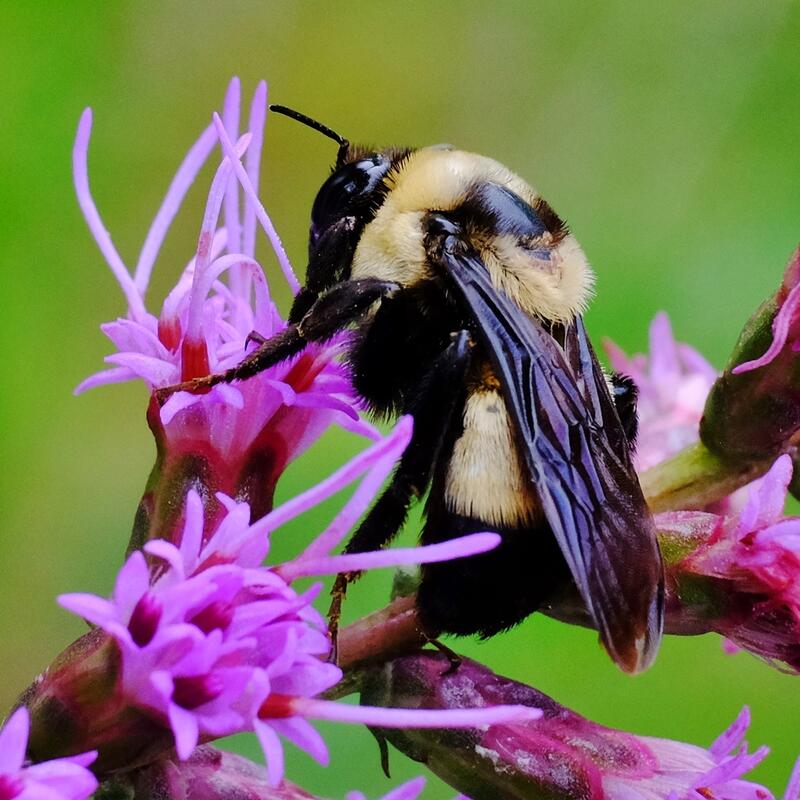
The Southern Plains Bumble Bee, Bombus fraternus, is a short-tongued bumble bee species that has been steadily declining over the past decade. Individuals of this species are pale yellow with black wings and have two distinct black bands, one between the wings and the other on the lower abdomen. Males and females look similar, but males have larger eyes and more yellow between the wings. This is a large species with queens measuring around 21-27 mm, males measuring around 19-25 mm, and workers measuring around 13-18 mm in length. They have very short, cropped, hair that is neat and uniform.
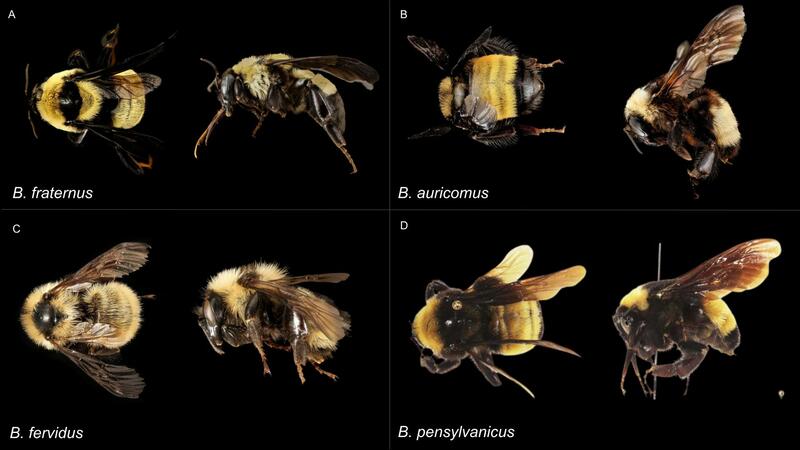
The most similar species are Bombus pensylvanicus, the American Bumble Bee, Bombus auricomus, the Black and Gold Bumble Bee, and Bombus fervidus, the Northern Golden Bumble Bee due to similar coloration and size. The absence of an upper, black band on its abdomen distinguishes B. fraternus from B. pensylvanicus and B. auricomus. A black band in the middle of the thorax distinguishes it further from B. pensylvanicus which has black on the lower half of the thorax. Larger size and less yellow on the abdomen distinguishes it from B. fervidus. Please refer to the species pictures below for a visual representation of the color patterns of these similar species.
This species is found in temperate grasslands, rural gardens, and urban areas. As long as there are nesting and floral resources available, bumble bees can persist in urban and suburban areas. They can nest either underground in rodent nests or above ground in tufts of grass, old bird’s nests, tree cavities, or piles of debris on the ground.
The Southern Plains Bumble Bee consumes pollen and nectar from a variety of flowers. Some examples of preferred flower species are “Milkweed (Asclepias), Prairie clovers (Dalea), Blazing stars (Liatris), Sweet clovers (Melilotus), Prairie coneflowers (Ratibida), and Goldenrod (Solidago)” (bumblebeeconservation.org).
Bombus fraternus is eusocial and has an annual generation cycle. A mated queen will overwinter and emerge in the spring to form her new colony. She will lay her eggs in wax cells containing pollen and nectar. Worker bees will emerge and begin to assist the queen with foraging and colony maintenance. The queen will continue to lay eggs throughout the summer. Males, also known as drones, and new queens will emerge at the end of summer. Drones will chase moving objects to find a mate. Newly mated queens will hibernate and find new nest locations to restart the cycle.
Search where preferred flowers are present. A sweep net could be used to collect workers while foraging. Bee Bowls, malaise traps, and vane traps could also be used.
B. fraternus is found in the Southeastern United States from central Florida to New Jersey and west throughout the United States Great Plains.
In Georgia, our records indicate that this species can be found throughout the state, though they are slightly more common in Central and South Georgia. However, we don’t have sufficient, recent data to accurately portray the GA range.
Residential and commercial development, agriculture, pesticide use, fire and fire suppression, invasive species, pollution, disease, and climate change are the main threats to this species.
One of the most noteworthy threats is habitat destruction caused by the conversion of grasslands into residential/commercial areas and agricultural fields. Related to this issue, pesticide use in these agricultural areas is also a major concern.
Ironically, both fire and fire suppression can also cause issues. Prescribed burns can restore grassland habitat, but also kill bumble bees and other insect species. Moreover, fire suppression can cause loss of habitat, especially in woodland areas.
Another major threat is disease spread from commercial bee species although not thoroughly studied in this species. This occurs when wild bee populations interact with commercially reared species while foraging.
| Threat 1 | Threat 2 | Threat 3 | |
|---|---|---|---|
| General Threat | Agriculture & aquaculture | Climate change & severe weather | Residential & commercial development |
| Specific Threat | Wood & pulp plantations | Habitat shifting & alteration | Commercial & industrial areas |
SNR - Unranked—Georgia conservation status not yet assessed.
Restoration of grassland habitat would be the greatest factor in the conservation of this species. This could be accomplished through the protection of natural grasslands to prevent land conversion. Prescribed burns could also be used to clear out the undergrowth and invasive plant species to allow native grasses and wildflowers to grow. Moreover, decreased pesticide use and protection from managed bee species to mitigate disease spread would also be beneficial steps in the conservation of this species.
About Bumble Bees. Xerces Society. n.d.. Retrieved from https://www.xerces.org/bumblebees/about.
Bombus pensylvanicus. Discover Life. n.d.. Retrieved from https://www.discoverlife.org/mp/20q?search=Bombus%2Bpensylvanicus.
Colla, S. R., Otterstatter, M. C., Gegear, R. J., & Thomson, J. D. 2006. Plight of the bumble bee: Pathogen spillover from commercial to wild populations. Biological Conservation, 129(4), 461–467. https://doi.org/10.1016/j.biocon.2005.11.013
Colla, Sheila & Richardson, Leif & Williams, Paul. 2011. Bumblebees of the eastern United States.
Cox, D. 2019. Bumblebees of the World Blog Series… #4 Bombus fraternus. Bumblebee Conservation Trust. Retrieved from https://www.bumblebeeconservation.org/bumblebees-of-the-world-blog-series-4-bombus-fraternus/.
Hatfield, R., Jepsen, S., Thorp, R., Richardson, L. & Colla, S. 2014. Bombus fraternus. The IUCN Red List of Threatened Species 2014: e.T44937623A69001851. https://dx.doi.org/10.2305/IUCN.UK.2014-3.RLTS.T44937623A69001851.en.
McFrederick, Q. S., & LeBuhn, G. 2006. Are urban parks refuges for bumble bees Bombus spp. (hymenoptera: Apidae)? Biological Conservation, 129(3), 372–382. https://doi.org/10.1016/j.biocon.2005.11.004
Moissett, B. n.d.. Species bombus fraternus - southern plains bumble bee. BugGuide.Net. Retrieved from https://bugguide.net/node/view/67084.
Williams, P.H., Thorp, R.W., Richardson, L.L. and Colla, S.R. 2014. The Bumble bees of North America: An Identification guide. Princeton University Press, Princeton.
Yahoo! 2021. USGS bee inventory and Monitoring Lab. Flickr. Retrieved from https://www.flickr.com/photos/usgsbiml/with/51493575062/.
Reagan Montalvo
12-14-2021