


Loading profile. Please wait . . .
Parmotrema perforatum (Jacq.) Massal.
Common Perforated Ruffle




Federal Protection: No US federal protection
State Protection: No Georgia state protection
Global Rank: G3G5
State Rank: SNR
Element Locations Tracked in Biotics: No
SWAP 2015 Species of Greatest Conservation Need (SGCN): No
SWAP 2025 Species of Greatest Conservation Need (SGCN): No
2025 SGCN Priority Tier:
Element Occurrences (EOs) in Georgia: 0
Habitat Summary for element in Georgia: Habitats with trees
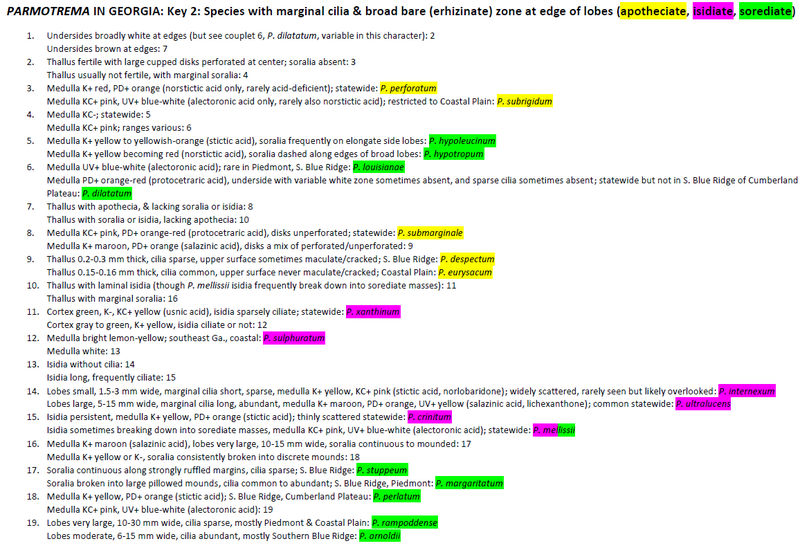
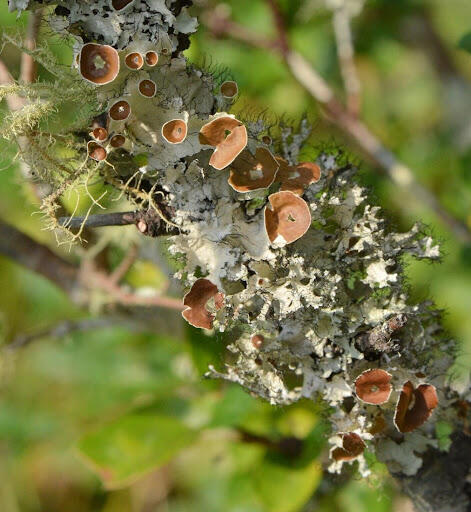
Pale gray thallus of broad (1-2 cm wide) lobes that arch away from substrate, giving the thallus a fruticose appearance; undersides white for all but the black center; lobe margins divided into long acute side lobes, with abundant, long black cilia; large, cupped apothecia pale to dark brown, with characteristic perforation at center; CHEMISTRY: medulla K+ red, KC-, C-, PD+ yellow-orange, UV- (norstictic acid); FIELD ID is straightforward north of the Fall Line, but in the Coastal Plain is most reliably told from the other Perforated Ruffle with a UV test to the medulla
Parmotrema subrigidum is almost identical, differing only by a tendency for paler disks, but best told by chemistry, medulla KC+ pink & UV+ blue-white (K- usually, but broadly also includes a few K+ red individuals with norstictic acid) (see key below)
None
Habitats with trees; substrates: hardwood bark: 32% Quercus, 7% Acer & 52% other hardwoods or unknowns; conifer bark: 6% Taxodium, 6 records on Pinus & 1 on Juniperus
Corticolous foliose lichenized fungus, photobiont a green alga (Trebouxia?)
None
Statewide
Unknown
Abundant
None
Brodo, I. M. 2001. Lichens of North America. Yale University Press, New Haven, Conn.
Brodo, I. M. 2016. Keys to lichens of North America: revised and expanded. Yale University Press, New Haven, Conn.
Esslinger, T. L. 2021. A cumulative checklist for the lichen-forming, lichenicolous and allied fungi of the continental United States and Canada. Version 24. Opuscula Philolichenum 20: 100-394.
Lendemer, J. C., R. C. Harris & A. M. Ruiz. 2016. A review of the lichens of the Dare Regional Biodiversity Hotspot in the Mid-Atlantic Coastal Plain of North Carolina, Eastern North America. Castanea 81: 1-77.
Malcolm Hodges
30 May 2022