

Loading profile. Please wait . . .
Parmotrema rampoddense (Nyl.) Hale
Long-whiskered Ruffle




Federal Protection: No US federal protection
State Protection: No Georgia state protection
Global Rank: G5
State Rank: SNR
Element Locations Tracked in Biotics: No
SWAP 2015 Species of Greatest Conservation Need (SGCN): No
SWAP 2025 Species of Greatest Conservation Need (SGCN): No
2025 SGCN Priority Tier:
Element Occurrences (EOs) in Georgia: 0
Habitat Summary for element in Georgia: Open woodlands, forests and swamps
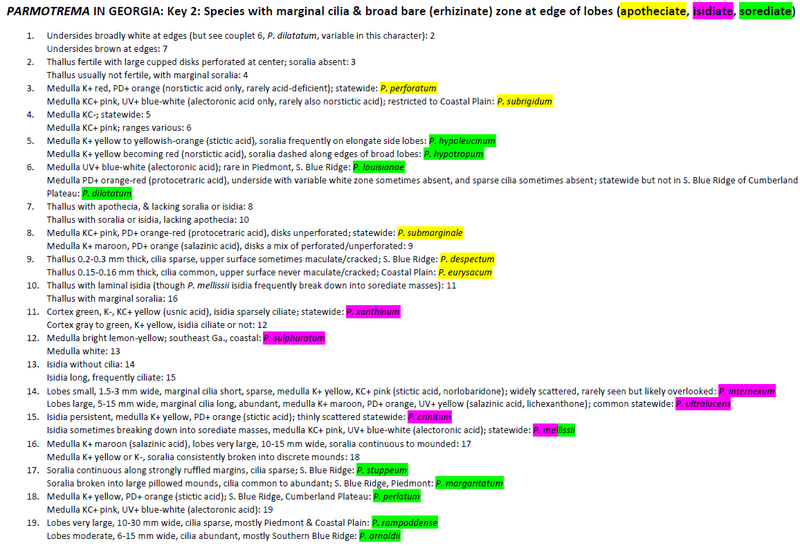
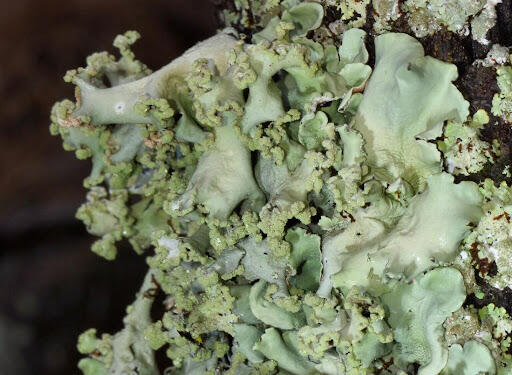
Pale green-gray thallus of broad (0.5-2 cm wide) lobes with undersides pale brown (rarely white) at lobe edges, black in center; old lobes edged with mounded gray-green soralia, narrow to thick; lobes with long black cilia, often sparse; CHEMISTRY: medulla K-, KC+ pink, PD-, UV+ blue-white (alectoronic acid); FIELD ID: the commonest big sorediate ruffle in its range, but use a UV test to sort from P. dilatatum in Coastal Plain & P. margaritatum in Piedmont
Parmotrema dilatatum is also often large, but its medulla is K-/+ pale yellow, C-, KC+ pink, PD+ red/orange, UV-; P. margaritatum is rare in the Piedmont, & has K+ maroon, UV- medulla (see key below)
Parmotrema diffractaicum
Open woodlands, forests & swamps; substrates: hardwood bark: 40% Quercus, 6% Prunus, 5% Nyssa & 31% other hardwoods or unknowns; conifer bark: 5% Juniperus & 5 records each on Pinus & Taxodium; 6 records on silicious rock & 1 each on moss over bark & decorticate wood
Corticolous foliose lichenized fungus, photobiont a green alga (Trebouxia?)
None
Coastal Plain, Piedmont
Unknown
Common
None
Brodo, I. M. 2001. Lichens of North America. Yale University Press, New Haven, Conn.
Brodo, I. M. 2016. Keys to lichens of North America: revised and expanded. Yale University Press, New Haven, Conn.
Esslinger, T. L. 2021. A cumulative checklist for the lichen-forming, lichenicolous and allied fungi of the continental United States and Canada. Version 24. Opuscula Philolichenum 20: 100-394.
Malcolm Hodges
26 May 2022