

Loading profile. Please wait . . .
Physcia pumilior R. C. Harris
Spotted Rosette




Federal Protection: No US federal protection
State Protection: No Georgia state protection
Global Rank: G4G5
State Rank: SNR
Element Locations Tracked in Biotics: No
SWAP 2015 Species of Greatest Conservation Need (SGCN): No
SWAP 2025 Species of Greatest Conservation Need (SGCN): No
2025 SGCN Priority Tier:
Element Occurrences (EOs) in Georgia: 0
Habitat Summary for element in Georgia: In wooded habitats
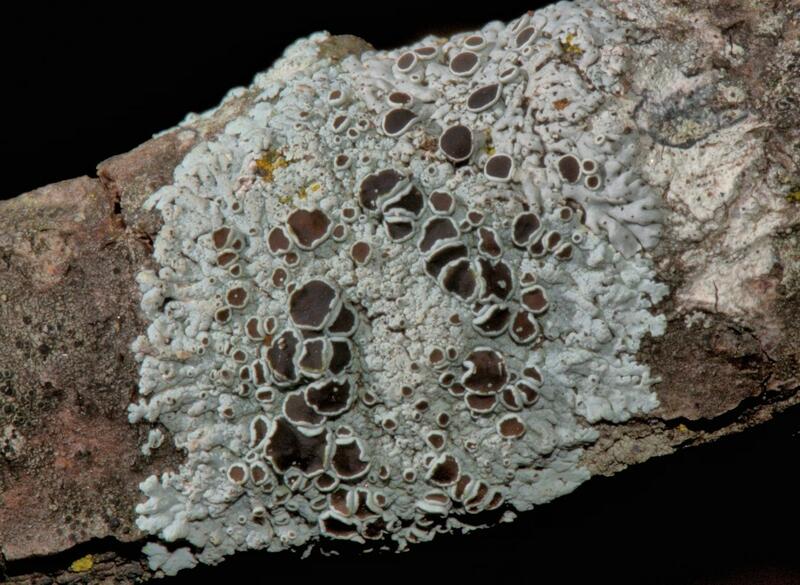
Gray to blue-green (wet) thallus of narrow, convex lobes 0.4-0.8 mm wide, often forming small rosettes; lobes maculate to bumpy; black, brown or gray-pruinose apothecia with thalline rims abundant at center of thallus, disks smooth (without rhizines) below; lower surface white with pale rhizines; CHEMISTRY: medulla K+ yellow (atranorin); FIELD ID: the common fertile member of this genus over most of state; see Similar Species
Physcia neogaea is rare away from the coast, has smooth lobes & often apothecia with a fringe of rhizines below; P. stellaris is rare outside mountains, is less maculate & has K- medulla (a difficult test to perform on such small lichens)
Physcia clementei, P. crispa, P. halei, P. pseudospeciosa
In wooded habitats; substrates: hardwood bark (usually twigs & small branches): 37% Quercus, 6% Liquidambar, 6% Ulmus, 5% Carya & 46% other hardwoods or unknowns; 1 record on Taxodium bark
Corticolous foliose lichenized fungus, photobiont a green alga (Trebouxia?)
None
Statewide, thinnest in lower Coastal Plain
Unknown
Common to abundant
None
Brodo, I. M. 2001. Lichens of North America. Yale University Press, New Haven, Conn.
Brodo, I. M. 2016. Keys to lichens of North America: revised and expanded. Yale University Press, New Haven, Conn.
Esslinger, T. L. 2021. A cumulative checklist for the lichen-forming, lichenicolous and allied fungi of the continental United States and Canada. Version 24. Opuscula Philolichenum 20: 100-394.
Malcolm Hodges
3 August 2022