

Loading profile. Please wait . . .
Usnea angulata Ach.
Rough Beard




Federal Protection: No US federal protection
State Protection: No Georgia state protection
Global Rank: G3G5
State Rank: S1S2
Element Locations Tracked in Biotics: No
SWAP 2015 Species of Greatest Conservation Need (SGCN): No
SWAP 2025 Species of Greatest Conservation Need (SGCN): Yes
2025 SGCN Priority Tier: High Conservation Concern
Element Occurrences (EOs) in Georgia: 0
Habitat Summary for element in Georgia: Mesic mixed forests near streams
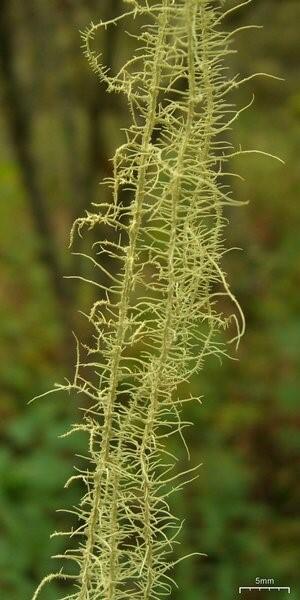
Pale yellow-green thallus of terete branches with an elastic (when wet) or hard central cord or axis; thallus pendent, up to 20 cm long, usually appearing angular & crumpled, without smooth arcs; branches with longitudinal ridges, often angular in cross-section; short acute-tipped branches called fibrils frequent along main branches; soralia near tips of branches common, small, containing both soredia & isidia, the latter sometimes also developing away from soralia; medulla thick, dense, white; CHEMISTRY: medulla K+ yellow turning red (norstictic, salazinic & galbinic acids); FIELD ID possible with experience
Other pendant Usnea in the mountains lack prominent longitudinal ridges
Usnea baileyi, U. dimorpha
Mesic mixed forests near streams; in Ga. noted on Alnus & Quercus bark
Corticolous fruticose lichenized fungus, photobiont a green alga (Trebouxia?).
Investigate likely streams in Southern Blue Ridge, starting from known locations
Southern Blue Ridge
Unknown (air pollution? climate change?)
| Threat 1 | Threat 2 | Threat 3 | |
|---|---|---|---|
| General Threat | Pollution | Invasive & other problematic species, genes & diseases | Climate change & severe weather |
| Specific Threat | Air-borne pollutants | Invasive non-native/alien species/diseases | Habitat shifting & alteration |
Rare, probably imperiled to critically imperiled in Ga. (ranked S1 in both N.C. & Va.); has apparently declined dramatically, now extirpated from most of historical range
A survey is needed
Brodo, I. M. 2001. Lichens of North America. Yale University Press, New Haven, Conn.
Brodo, I. M. 2016. Keys to lichens of North America: revised and expanded. Yale University Press, New Haven, Conn.
Esslinger, T. L. 2021. A cumulative checklist for the lichen-forming, lichenicolous and allied fungi of the continental United States and Canada. Version 24. Opuscula Philolichenum 20: 100-394.
Harris, R. C. & D. Ladd. 2005. Preliminary draft: Ozark lichens. Unpublished manuscript, New York Botanical Garden, Bronx, NY.
Malcolm Hodges
2 August 2022