

Loading profile. Please wait . . .
Usnea rubicunda Stirton
Red Beard




Federal Protection: No US federal protection
State Protection: No Georgia state protection
Global Rank: G4G5
State Rank: SNR
Element Locations Tracked in Biotics: No
SWAP 2015 Species of Greatest Conservation Need (SGCN): No
SWAP 2025 Species of Greatest Conservation Need (SGCN): No
2025 SGCN Priority Tier:
Element Occurrences (EOs) in Georgia: 0
Habitat Summary for element in Georgia: Forests and woodlands
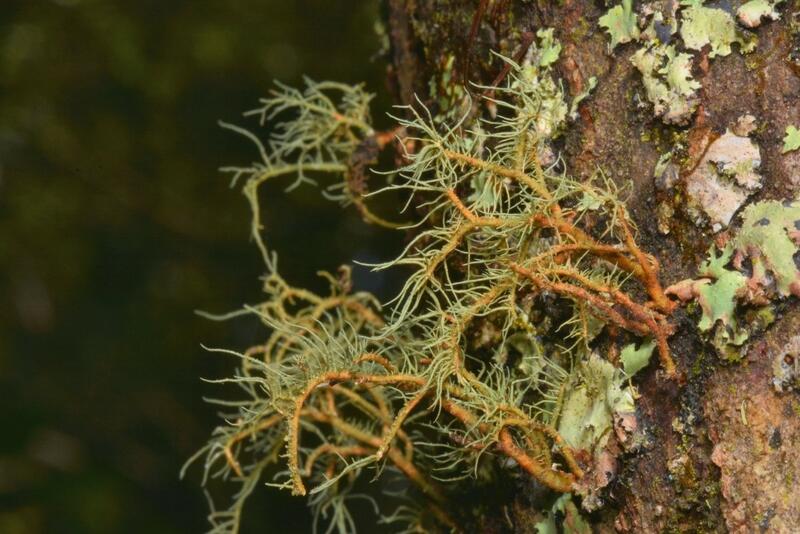
Thallus of terete branches with an elastic (when wet) or hard central cord or axis, cortex color ranging from green with a few splashes of pigment to entirely orange or rust in full sun; thallus shrubby to sub-pendent, fibrils common, sometimes contrastingly green; isidia common to abundant near branch tips, singly and in groups, also green, sometimes obscuring thallus color beneath; medulla thin & dense, white, axis white; CHEMISTRY: medulla K+ yellow, PD+ orange (stictic acid); FIELD ID: when well pigmented, unmistakable; take care to examine green examples for patches of pigment (and see additional caution in Similar Species)
Our only Usnea with a pigmented cortex (beware sick or dying beard lichens that turn reddish-brown)
Usnea baileyi, U. dimorpha
Forests & woodlands; substrates: hardwood bark: 37% Quercus & 40% other hardwoods or unknowns; conifer bark: 5% Juniperus, 5% Pinus & 5 records on Taxodium; 9% on silicious rock
Corticolous fruticose lichenized fungus, photobiont a green alga (Trebouxia?).
None
Statewide
Unknown
Common
None
Brodo, I. M. 2001. Lichens of North America. Yale University Press, New Haven, Conn.
Brodo, I. M. 2016. Keys to lichens of North America: revised and expanded. Yale University Press, New Haven, Conn.
Esslinger, T. L. 2021. A cumulative checklist for the lichen-forming, lichenicolous and allied fungi of the continental United States and Canada. Version 24. Opuscula Philolichenum 20: 100-394.
Malcolm Hodges
2 August 2022