

Loading profile. Please wait . . .
Usnea strigosa (Ach.) Eaton
Common Bushy-beard




Federal Protection: No US federal protection
State Protection: No Georgia state protection
Global Rank: G5
State Rank: SNR
Element Locations Tracked in Biotics: No
SWAP 2015 Species of Greatest Conservation Need (SGCN): No
SWAP 2025 Species of Greatest Conservation Need (SGCN): No
2025 SGCN Priority Tier:
Element Occurrences (EOs) in Georgia: 0
Habitat Summary for element in Georgia: Woodlands, forests and swamps
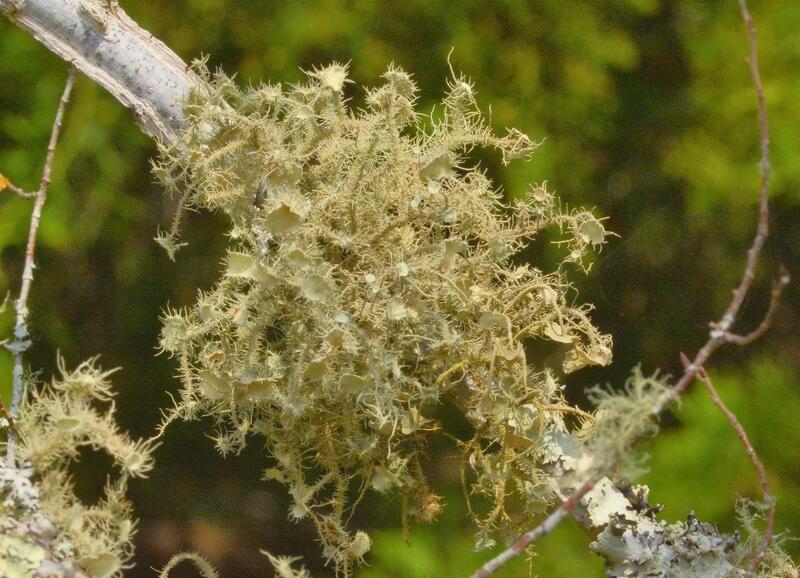
Pale green thallus of terete branches with an elastic (when wet) or hard central cord or axis; thallus shrubby, with abundant fibrils crowding branches; soralia & isidia absent; apothecia usually present, sometimes abundant, at first cupped then becoming flat, with fibrils along edges; medulla variably red, pink or occasionally all-white; axis thick, pink to white; MICROSCOPY: oval, colorless spores average shorter than 9 µm, variably 7-10 µm long; CHEMISTRY: medulla with norstictic acid (K+ red, needle-like crystals forming in KOH wet mount under high magnification), but some variants produce psoromic acid (K-, PD+ bright yellow), some thamnolic acid (K+ deep yellow, PD+ orange), & some are acid-deficient; FIELD ID: requires spore measurements to ID to species
Other Usnea species reproduce mostly via diaspores (soredia, isidia), & rarely if ever produce apothecia (U. subscabrosa perhaps more than the rest); 3 other typically fertile Usnea without soredia or isidia occur in Ga.: U. endochrysea (indistinguishable from U. strigosa without dissection), with spores averaging more than 9 µm long; U. evansii, a Coastal-Plain species with a consistently white medulla, low ridges running down branches with fibrils arranged in lines along these, & with galbinic acid in its medulla (K+ orange-red, PD+ orange, with blunt-ended rectangular crystals in KOH wet mount); U. subfusca, rare at the highest elevations in Ga., is large & floppy with large apothecia, has a consistently white medulla, & has salazinic acid in its medulla (K+ red turning dark red then almost black, no crystals produced)
Usnea baileyi, U. dimorpha
Woodlands, forests & swamps; substrates: mostly hardwood bark: 36% Quercus & the rest on other hardwoods or unknowns; 1 record on silicious rock
Corticolous fruticose lichenized fungus, photobiont a green alga (Trebouxia?).
None
Statewide
Air pollution can reduce numbers & retard development of thalli, possibly suppressing formation of apothecia
Common to abundant (many specimens collected in Georgia await dissection)
None
Brodo, I. M. 2001. Lichens of North America. Yale University Press, New Haven, Conn.
Brodo, I. M. 2016. Keys to lichens of North America: revised and expanded. Yale University Press, New Haven, Conn.
Esslinger, T. L. 2021. A cumulative checklist for the lichen-forming, lichenicolous and allied fungi of the continental United States and Canada. Version 24. Opuscula Philolichenum 20: 100-394.
Lendemer, J. C., R. C. Harris & A. M. Ruiz. 2016. A review of the lichens of the Dare Regional Biodiversity Hotspot in the Mid-Atlantic Coastal Plain of North Carolina, Eastern North America. Castanea 81: 1-77.
Malcolm Hodges
2 August 2022