

Loading profile. Please wait . . .
Usnea subgracilis Vainio
Long Beard




Federal Protection: No US federal protection
State Protection: No Georgia state protection
Global Rank: G4G5
State Rank: SNR
Element Locations Tracked in Biotics: No
SWAP 2015 Species of Greatest Conservation Need (SGCN): No
SWAP 2025 Species of Greatest Conservation Need (SGCN): No
2025 SGCN Priority Tier:
Element Occurrences (EOs) in Georgia: 0
Habitat Summary for element in Georgia: Montane hardwood forest
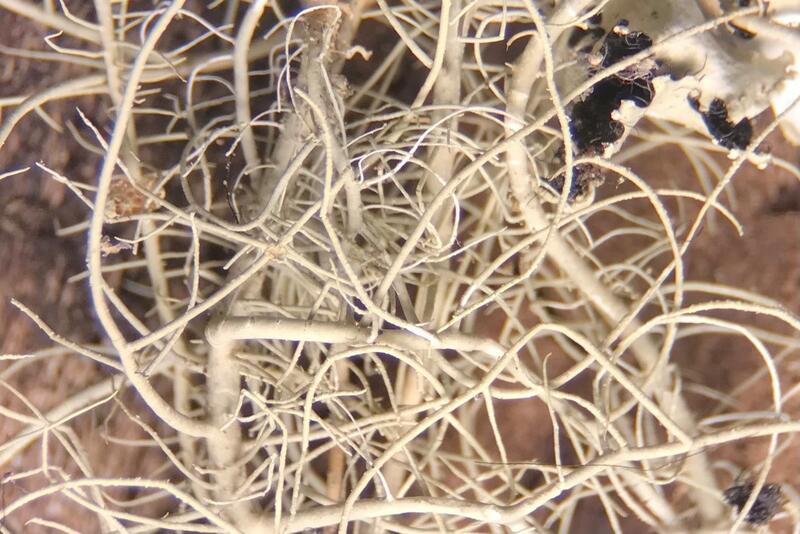
Green thallus of terete branches with an elastic (when wet) or hard central cord or axis; thallus sub-pendent to pendent, with long, narrow, graceful branches; long, narrow fibrils/side branches are only slightly curved, interspersed along branches; isidia are sparsely scattered along branch tips, often only 1/soralium; medulla narrow, dense, white, axis & cortex thin; CHEMISTRY: medulla K-, KC+ pink, PD+ red (protocetraric acid); FIELD ID: requires chemical tests & dissection to ID
Usnea subgracilis is the only long, graceful beard in the mountains with a PD+ red medulla; it is not as stout or stiff as U. ceratina (CK+ orange, P-) & lacks the warts of that species; nor is it as shrubby and stiff as U. subscabrosa (also P+ red) which has larger soralia with many isidia; U. diplotypus has different medullar chemistry (K+ red, P-)
Usnea baileyi, U. dimorpha
Montane hardwood forest; substrates: mostly hardwood bark, with no particular predilection evident; 2 records on Tsuga bark, & 5 records on silicious rock
Corticolous fruticose lichenized fungus, photobiont a green alga (Trebouxia?).
None
Southern Blue Ridge
Unknown
Common
None
Brodo, I. M. 2001. Lichens of North America. Yale University Press, New Haven, Conn.
Brodo, I. M. 2016. Keys to lichens of North America: revised and expanded. Yale University Press, New Haven, Conn.
Esslinger, T. L. 2021. A cumulative checklist for the lichen-forming, lichenicolous and allied fungi of the continental United States and Canada. Version 24. Opuscula Philolichenum 20: 100-394.
Tripp, E. A. & J. C. Lendemer. 2020. Field guide to the lichens of Great Smoky Mountains National Park. The University of Tennessee Press, Knoxville.
Malcolm Hodges
2 August 2022