


Loading profile. Please wait . . .
Sternotherus peltifer Smith and Glass, 1947
Stripe-necked Musk Turtle




Federal Protection: No US federal protection
State Protection: No Georgia state protection
Global Rank: GNR
State Rank: SU
Element Locations Tracked in Biotics: Yes
SWAP 2015 Species of Greatest Conservation Need (SGCN): No
SWAP 2025 Species of Greatest Conservation Need (SGCN): Yes
2025 SGCN Priority Tier: Data Deficient
Element Occurrences (EOs) in Georgia: 17
Habitat Summary for element in Georgia: Big rivers, reservoirs, rivers and streams and floodplains
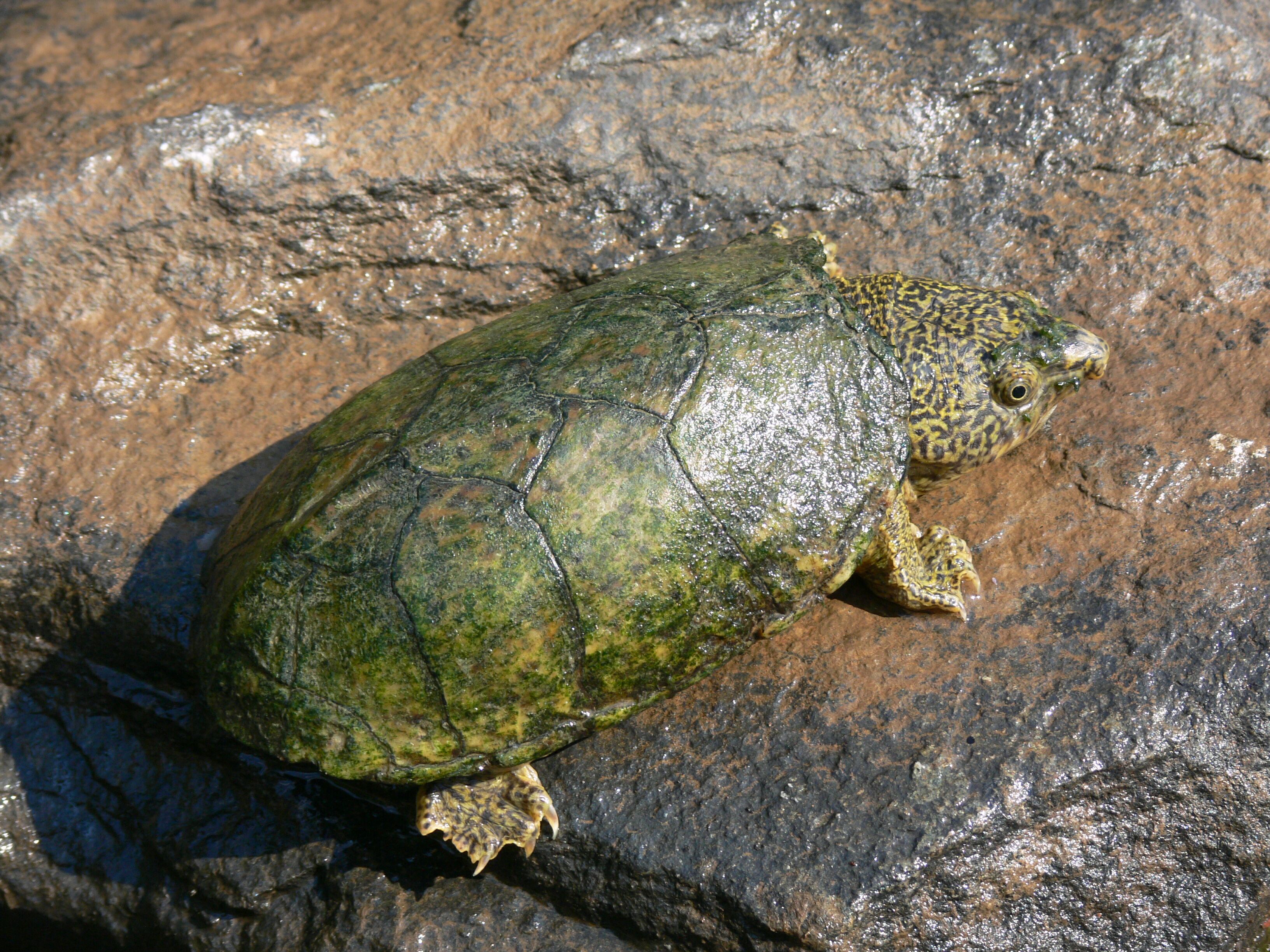
As is the case for all kinosternids (mud and musk turtles, family Kinosternidae), this turtle has a total of 23 marginal scutes (including the cervical scute) on the perimeter of the carapace (topside of shell). The carapace of the stripe-necked musk turtle ranges from 7.6-10.2 cm (3-4 inches, straight carapace length), with a maximum of 11.7 cm (4.6 inches). The olive-brown carapace has sparse dark brown spots and a single mid-dorsal keel (ridge), lacking lateral keels; both these spots and the keel are usually subdued in adults. The carapace scutes (bony external plates that make up the shell) are imbricated (have the appearance of slightly overlapping each other), and the borders between these scutes tend to be darker than the overall shell color; the marginal scutes of the carapace are flared. The plastron (underside of shell) is fairly small compared to the species’ relative body size and varies in color from brown-orange, light pink, to dark brown. The plastron has a single anterior hinge and a single gular scute is present anteriorly. Barbels, which are small fleshy tubercles of the skin used to detect scent in the environment, are only present on the chin in this species. The top of the head is reticulated with dark gray/black and tan/yellow colored pattern (some individuals are more vivid than others), eventually combining to form gray/black and tan/yellow stripes from the back of the head, down the sides of the neck. These stripes are most visible when the neck is stretched out. Males have a pattern of dark lateral stripes on the side of their tail as well as a blunt spine or nail at the end of their tail. Males also have rough patches on the insides of the hind legs. Hatchlings (2.3-2.8 cm or 0.9-1.1 inches in carapace length) have strongly striped necks and a yellow-orange plastron; the mid-dorsal keel of the carapace is most pronounced in juveniles.
The stripe-necked musk turtle may be confused with other North American kinosternids, including those with the genus Kinosternon (mud turtles), but especially other turtles of the genus Sternotherus (musk turtles). These musk turtles include the loggerhead musk turtle (Sternotherus minor), the eastern musk turtle (S.odoratus), the intermediate musk turtle (S. Intermedius), the razor-backed musk turtle (S. carinatus), and the flattened musk turtle (S. depressus); the latter three species not occurring in Georgia. The eastern musk turtle is a sister species that is most easily confused with S. peltifer due to its physical resemblance, though it usually lacks stripes on its head and neck and has lateral keels on the carapace (as adults). The eastern musk turtle has a pair of cream-colored stripes running along each side of its head, originating from above and below its nostrils, its eye in between, and down its neck in place of the iconic neck stripes of S. peltifer and lacks pronounced lateral keels on the carapace. Additionally, it has barbels on both the chin and neck whereas S. peltifer only has a pair on the chin. As its name implies, the physical characteristics of the intermediate musk turtle are intermediate between S. peltifer and S. minor, possessing some degree of striping on the sides of the neck and lateral keels of the carapace reduced or completely lacking in some populations. The razor-backed musk turtle lacks a gular scute and is more laterally compressed, with a larger space between its head and its shell. The flattened musk turtle has a much more dorsoventrally compressed shell and serrated/flared marginal scutes and bares a striped or reticulated pattern of yellow and black on the head and neck similar to that of S. peltifer, but should not be confused with the striped-neck musk turtle given this species’ distinct flattened shell. The eastern mud turtle (Kinosternon subrubrum) is the only mud turtle that is sympatric (i.e., overlapping geographic distribution) with S. peltifer. Mud turtles have relatively large plastrons compared to that of musk turtles; no skin shows along the seams of the plastral scutes (contrasting to that which is typical of Sternotherus). The pectoral scutes of the plastron of the eastern mud turtle are usually triangular in shape (forming the letter “K” against the anterior hinge, which is typical of Kinosternon), whereas within turtles of the genus Sternotherus, pectoral scutes are generally squarish in shape.
Habitat preference of S. peltifer generally consists of lotic wetlands (i.e., flowing waters); in contrast, its sister species, S. minor, prefers lentic wetlands (i.e., stagnant or slower moving current). Although found within impoundments occurring along natural stream channels that have been dammed, striped-necked musk turtles generally tend to be a riverine/stream dweller in swallow waters. Though specific microhabitat preferences are scantly documented within the literature, in middle Tennessee, S. peltifer is known to frequently utilize underwater limestone bluffs as shelter.
In Alabama, the striped-necked musk turtle’s diet is known to consist of snails (46%) and insects (30%), with an occasional crustacean (7%). This turtle is most active at night, likely due to foraging habits. Though the striped-necked musk turtle’s diet is roughly the same as S. minor, differences in habitat preference undoubtedly necessarily equate to differences in prey availability. While not documented for S. peltifer, the loggerhead musk turtle has been reported to occasionally display cannibalistic behaviors on smaller turtles. Due to interspecies food resources competition, the jaws of individual striped-necked musk turtles have been shown to display reduced musculature and surface area within the Tennessee River drainage of north-central Alabama where the snail Elimia (i.e., a genus of aquatic gastropod mollusk characterized by a high-spired, robust shell) is absent or where the species is sympatric with S. odoratus. Competition between S. peltifer and other turtle species has not been studied, but similar morphological differences due to competition could be found.
Unlike its sister species (S. minor) which primarily forages at twilight and the early part of the night, S. peltifer forages mostly in the morning, although it is frequently active both day and night. Although the basking habit is not well developed within this species (primarily basking within shallow water with carapace exposed), the striped-necked musk turtle is an ardent climber (nearly unrivaled within the chelonian world); in fact, it is not uncommon for this species to climb to a perch on a branch a few feet above the edge of the stream that it inhabits. Morphology of the shell of striped-necked musk turtles from the Cahaba River drainage basin in central Alabama have been found to be more dorsoventrally compressed above the Fall Line compared to individuals from the Coastal Plain; this morphological pattern aligns with other turtle species and it is therefore theorized that this observed trend may reflect an evolutionary adaptation to variation in respective regional wetland water velocity, but more research is needed. Nesting occurs from mid- to late May to July. Females may lay from 1-5 clutches annually, each clutch consisting of 1-5 eggs, laid either singularly or in groups within swallow soil, often at the base of trees or beside logs (sometimes communally); incubation normally takes from 61-120 days. Sex of individual striped-necked musk turtles is determined by the temperature at which the egg incubates during embryonic development while in the nest. For S. peltifer, the appliable pattern is where both extreme high and extreme low temperatures produce females, while moderate temperatures produce males (i.e., temperature sex determination pattern TSD–2). Specifically for this species, females are produced at temperatures of higher than 30°C (86°F) and lower than 24°C (75°F). Females are predominately produced from 27-30°C (81-86°F), and at 24°C (75°F); males are predominately produced at the intermediate temperatures, 25-26°C (77-79°F).
Snorkeling surveys are recommended in rivers and streams with moderate to swift current within the presumed range of this turtle. Since striped-necked musk turtles are not particularly attracted to bait, the deployment of fyke net-modified hoop net traps are often less effective than the placement of funnel/basket traps within swallow flowing waters in the capture of this species. However, use of such turtle traps is only legal in Georgia by issuance of a permit by the Georgia Department of Natural Resources. Specifically, the north-central portion of the Chattahoochee River drainage in Georgia should be surveyed as this area likely serves as a divide between S. minor to the south and S. peltifer to the north. Hybrids of these two species have been recorded in Alabama where their habitats overlap but extensive surveys have not been conducted for S. peltifer or hybrids in Georgia.
In Georgia, striped-necked musk turtles occur within the Cumberland Plateau, Ridge and Valley, and Blue Ridge ecoregions within the Coosa and Tennessee river basins, the Chickamauga Creek drainage in northwest Georgia, and most likely from the north-central portion of Chattahoochee River drainage. Range-wide, S. peltifer occurs in the greater Mobile River Basin of Alabama, Mississippi, Tennessee, and Georgia, the portions of the Tennessee River drainage of Tennessee, Mississippi, Alabama, Virginia and North Carolina, the Pascagoula River drainage of Mississippi and Alabama, and the Pearl River drainage of Louisiana and Mississippi. The range of stripe-necked musk turtles’ sister species, S. minor, borders S. peltifer’s distribution to the south and east. Interspecific competition between these turtles may limit and define their respective distributions, but the degree to which hybridization between these two species occurs as well as the precise contact zone of these species’ geographic distributions in the vicinity of the north-central Chattahoochee River drainage in Georgia remains to be adequately investigated. Further research is needed to determine if such hybridization might possibly occur within the north-central Chattahoochee River drainage in Georgia, possibly acting as the geographical divide between these two species.
The striped-necked musk turtle was first described in 1947 as a subspecies of S. minor and subsequently promoted to full species in 2018 based on demonstrated genetic differentiation from the loggerhead musk turtle. The major threat to the long-term conservation of this turtle is potential habitat degradation, through dredging, impoundment, or pollution of riparian habitat. Dredging and impoundment can effectively eliminate the availability of suitable riparian habitat through inundation and/or the physical removal of habitat structure (submerged large woody debris). Possible sources of pollution include point sources (industrial pollution) and non-point sources, such as chemical runoff as well as siltation due to soil erosion from changes in land use along river corridors. Musk turtles are frequently caught on baited hooks by anglers, which can lead to the death or serious injury of the individual when the hook is removed. The extent to which overharvest occurring within Georgia streams before the enactment of restrictive regulations in 2018 might possibly have effected the viability of local striped-necked musk turtle populations remains unknown; however, regulations addressing the permissible harvest of the species that are currently in place are adequate to prevent future overharvest with proper enforcement.
| Threat 1 | Threat 2 | Threat 3 | |
|---|---|---|---|
| General Threat | Biological resource use | None | None |
| Specific Threat | Hunting & collecting terrestrial animals | None | None |
This species is designated a Species of Greatest Conservation Need (SGCN) within the 2025 revision of Georgia’s SWAP with the recognition that past overharvest of striped-necked musk turtles in Georgia may have depleted local populations and that there have been insufficient formal surveys done to determine a conservation status for this turtle. The only confirmed occurrence of this species on conservation lands within Georgia falls within the Chattahoochee National Forest, but this turtle almost certainly occurs within the Conasauga River Wildlife Managment Area; additional survey effort will undoubtedly reveal the presence of this turtle within other conservation lands as well. As is the case for all non-protected freshwater turtle species in Georgia, there is no closed season for the harvest of the striped-necked musk turtle in Georgia. However, Georgia’s freshwater turtle regulations (Chapter 391-4-16) do provide some restriction to harvest; no freshwater turtle eggs may be harvested from the wilds of Georgia and no more than 10 freshwater turtles (any combination of species) may be possessed without a commercial turtle permit. Further, turtle traps can only legally be deployed in Georgia within public or private waters by a permitted nuisance wildlife control operator or through the issuance of a commercial fishing permit in conjunction with a commercial turtle-farming permit issued by the Georgia DNR.
Maintaining the integrity of north Georgian rivers and streams will help protect this specie. Preventing siltation or erosion may also help to conserve their habitat. Constructing dams and dykes may slow or stop the current needed for S. peltifer to survive in certain streams. The long-term survey and monitoring of select Georgia populations should be initiated and periodically monitored in order to establish baseline demographics and to identify possible future population declines. Impacts to riparian habitats from upland land use should be minimized; forestry best management practices including the implementation of stream management zones within the turtle’s range should be implemented during forestry operations in order to minimize erosion of the uplands and sedimentation input into adjacent stream channels.
Ennen, J. R. and A. F. Scott. 2008. Diel movement behavior of the stripe-necked musk turtle (Sternotherus minor peltifer) in Middle Tennessee. American Midland Naturalist, 160(2): 278–288.
Ennen, J. and F. Scott. 2013. Home range characteristics and overwintering ecology of the stripe-necked musk turtle (Sternotherus minor peltifer ) in Middle Tennessee. Chelonian Conservation and Biology 12: 199-203.
Folkerts, G. W. 1968). Food habits of the stripe-necked musk turtle, Sternotherus minor peltifer Smith and Glass. Journal of Herpetology 2(3/4):171–173.
O’brien, S. C., & Brown, G. J. (2024). Sternotherus Peltifer. Herpetological Review, 55(2), 256.
Rhodin, A.G.J., J. B. Iverson, U. Fritz, N. Gallego-García, A. Georges, H. B. Shaffer, and P. P. van Dijk. [Turtle Taxonomy Working Group]. 2025. Turtles of the World: Annotated Checklist and Atlas of Taxonomy, Synonymy, Distribution, and Conservation Status (10th Ed.). In: Rhodin, A. G. J., J. B. Iverson, P. P. van Dijk, C. B. Stanford, E. V. Goode, K. A. Buhlmann, and R. A. Mittermeier.(Eds.). Conservation Biology of Freshwater Turtles and Tortoises: A Compilation Project of the IUCN/SSC Tortoise and Freshwater Turtle Specialist Group. Chelonian Research Monographs 10: 1-575.
Scott, P. A., T. C. Glenn, L. J. Rissler. 2018. Resolving taxonomic turbulence and uncovering cryptic diversity in the musk turtles (Sternotherus) using robust demographic modeling. Molecular Phylogenetics and Evolution 120: 1–15.
Scott, P. A., T. C. Glenn, and L. J. Rissler, L. J. 2019. Formation of a recent hybrid zone offers insight into the geographic puzzle and maintenance of species boundaries in musk turtles. Molecular ecology, 28(4): 761–771.
Smith, H. M. and B. P. Glass. 1947. A new musk turtle from Southeastern United States. Journal of the Washington Academy of Sciences 37(1):22–24.
Tinkle, D. W. 1956. The systematics and ecology of the Sternotherus carinatus complex (Testudinata: Chelydridae). Tulane University Proquest Dissertations & Theses, 1–15.
Welc, M. S. 2021. Evolutionary ecology of stripe-necked musk turtles (Sternotherus peltifer) in the Cahaba River drainage. Auburn University ProQuest Dissertations & Theses, 1–8
Kennedy R. Funa and Thomas M. Floyd
K. Funa & T. Floyd, September 2025: original account